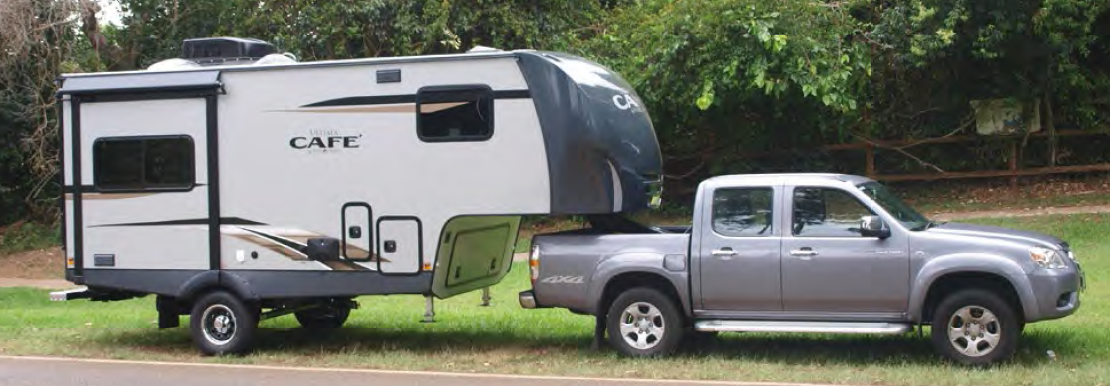
As I have discussed in previous Tech Notes, a correctly configured fifth-wheel caravan is far more stable than a conventional caravan. This is because the latter is towed via an overhung hitch that, when the caravan yaws in one direction causes the tow vehicle to yaw in the other direction. If this occurs at speed the yaw builds up, and if it exceeds a certain angle above a critical speed (specific to each rig), becomes literally non-correctable. This can and does happen. One local insurer alone advised of more than 130 conventional caravan rollovers in 2012.
A correctly set up fifth wheeler has its hitch directly over or marginally in front of the tow vehicle’s rear axle. While it may still yaw slightly that yaw will generally self-correct, providing about 20 percent of the caravan’s weight is carried by that hitch.
By and large most locally-made fifth-wheel caravans are relatively light and the desired nose weight can be achieved with the caravan’s axles set well back. Some imports, however, are heavier: to keep nose weights to the level that most locally available utes can bear (typically 700 kg – 1000 kg) the wheels are located further forward. This tends to introduce ongoing fore and aft rocking that causes the hitch to move in a vertical arc. This imposes a fore and aft lateral force, resulting in a shunting movement that bothers the driver and passenger/s. It is partially masked by a rubber or air-sprung hitch.
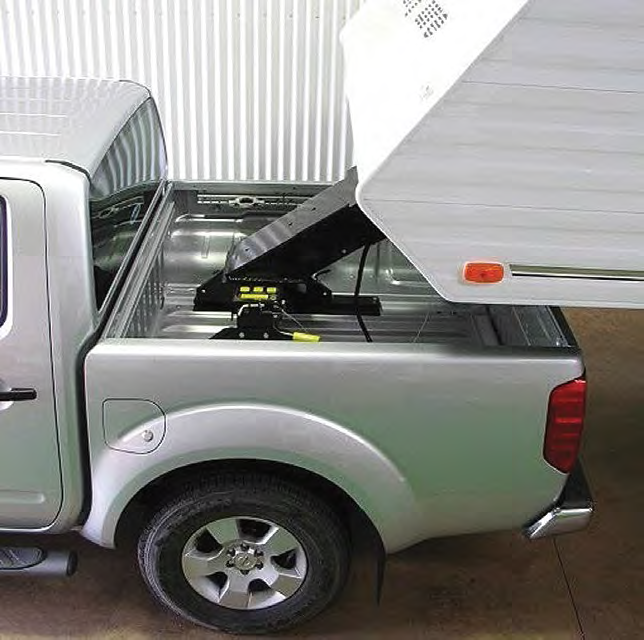
Whereas the above primarily degrades comfort, fifth wheeler dynamic stability is prejudiced if the hitch of any fifth wheeler is located to the rear of the tow vehicle’s rear axle/s, as is increasingly being done with dual-cab utes. This issue has arisen also with heavy commercial semi-wheel trailers where the tow vehicle has a rearward extended sleeping cabin.
A hitch located to the rear of the tow vehicle’s axle/s introduces an overhang in a similar manner to that of a conventional caravan’s tow hitch: and with the same undesirable results. As the trailer yaws in one direction the yaw forces causes the tow vehicle to yaw in the opposite direction. While the overhang is less than that with a conventional caravan, the weight carried by a fifth wheeler’s hitch is typically twice or more of that caravan. The hitch is also positioned very much higher. This introduces a vertical lever effect (technically called a ‘moment arm’) that, when cornering or yawing, causes the fifth wheeler’s centre of gravity, and thus imposed weight, to in turn cause the rear of the tow vehicle to roll and transfer weight to its outer rear tyre.
A tyre’s footprint on the road is unusual in that it does not follow the normal (Coulomb) laws of friction. While that increased weight increases the tyre’s frictional grip – that grip is also partially molecular – it does so at only three-quarters or so of the side forces associated with that yaw. In other words, as the load increases, the ability of that outer tyre to resist cornering force decreases.
It does not, however, affect the front outer tyre to the same extent. This effect causes the rear of the tow vehicle to run wide and to turn into the curve. The curve may progressively tighten until the yaw forces overwhelm the rear tyres and the rig jack-knifes.
Studies have shown that as that hitch is moved even slightly to the rear of the axle, the dynamic response of the rig becomes, to quote Dahlberg and Wideberg1, ‘highly non-linear and unpredictable’.
The occasionally seen more extreme rear hitch locations result in a fifth-wheel rig that in many ways is even less stable than a large end-heavy caravan pulled by a towing vehicle that is lighter.
While less probable, another cause of instability is where the fifth-wheel caravan has too little nose weight. This is because the roll associated with a side force, such as cornering, is then reacted almost totally by the outer rear tyres of that trailer. This will cause those tyres to ‘run wide’ such that the rear of the trailer adopts an increasing yaw that may build up to a non-recoverable jack-knifing. Too much nose weight, however, may reduce the rig’s ability to swerve.
This link http://towingdynamics.blogspot.com.au/ brings up a simulated demonstration of what happens with 3-,15- and 50 percent tow hitch weight.
Fifth-wheel trailer reality is that, unless that hitch really is over or in front of the tow vehicle axle or between the axles of a dual-axle tow vehicle, that unit cannot be regarded (dynamically at least) as anything but a potentially unstable conventional caravan with a gooseneckshaped hitch – and with the extent of instability non-linearly proportional to the distance of that hitch behind the axle. A centimetre or two may not matter but it would be a legally foolish technical writer to suggest other than that.
Reference
1 Dahlberg Erik and Wideberg Johan P. Department of Road Safety Research, Södertälje, Sweden.