To many, the differences between a fifth wheel caravan and a conventional caravan seem minor. The former’s hitch is (or should be) over the tow vehicle’s axle. The latter’s hitch is a fair way behind it. That seemingly minor difference results in very different on-road behaviour.
It affects stability such that a conventional caravan is inherently unstable, but tameable within limits. A fifth wheeler is inherently stable – but only if its hitch is directly over the tug’s rear axle. If to the rear, however, it behaves like a conventional caravan with excess nose weight.
The commercial transport industry realised (by 1920) that this difference is fundamental. Trailers prior to that, towed via overhung hitches, frequently rolled over. That the overhang was the cause was soon proven. Led by Fruehauf, the transport industry moved en masse to the concept of fifth wheeler caravans.
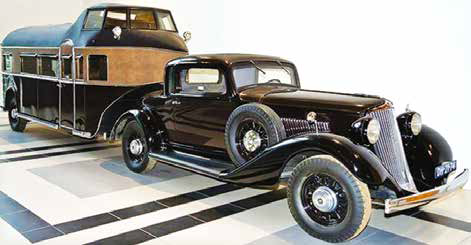
The first known fifth wheel caravan was in 1917. They were very popular in the 1930s, for example, Curtiss’s superb fifth wheelers towed by big Packards with the hitch over their rear axle. Some were complete with passenger accommodation.
ISSUES OF AN OVERHUNG HITCH
A tow hitch distanced behind the tow vehicle’s rear axle not only allows the tow vehicle and caravan to sway (yaw), it causes that. If the caravan yaws (snakes) clockwise, it causes the tug to yaw anti-clockwise and vice versa. The greater that hitch overhang, the greater the effect. Each in effect, feeds the other. Unless dampened, yaw escalates and the rig may jack-knife.
A fifth-wheeler; however, pivots directly above the tug’s axle (with big ones, such location is obligatory). Fifth-wheelers rarely yaw but except in extreme cases, that imposes no adverse forces on the tug (as with a swinging pendulum, no side force is imposed on its pivot). Any rearward location of the hitch however, negates this action. Dynamically, (and with heavier ones, legally) it is not a fifth-wheeler.
OPTIMISING A FIFTH-WHEELER
For optimum stability (and ride comfort), a fifth wheeler requires rear located axles, such that they carry about 75 per cent of trailer weight. Tow ball mass is required for stability, but its amount is far less critical than for conventional caravans. From 15-25 per cent nose weight assists fifth-wheeler tow vehicle traction and braking. Locally made (or designed) fifth-wheelers are designed accordingly.
Many imports are so heavy that the only way to keep hitch mass acceptable requires centrally located axles. This introduces an annoying shunting effect. It is fixable by using an air sprung hitch but better addressed by avoiding its source.
The ratio of tow vehicle weight to towed weight is less critical. Legally, for tow vehicles less than 4.5 tonne, maximum laden trailer weight is now the lesser of that allowed by the tow vehicle, tow hitch, or the rated maximum trailer mass.
OPTIMISING CONVENTIONAL CARAVANS
Conventional caravans naturally yaw. If well designed, laden as intended and towed by a heavy enough vehicle, such yaw is dampened by tyre hysteresis (akin to friction). It is also opposed by the inertia (resistance to change direction) of the tow vehicle.
Further, it is also reduced by having the caravan about 10 per cent front end heavy, avoiding extreme rear end weight, and having a tow vehicle of at least the same laden weight (ideally 30 per cent heavier).
Unless the above is observed, yaw may escalate. If this happens above a critical speed (specific to each rig), it may jack-knife and roll over. In 2013, one of Australia’s five caravan insurers alone reported 135 such incidents, refer to http://caravanbuyersguide.com.au/caravan-accidents.
That caravans inherently yaw is not disputed but in my opinion, not all local industry addresses the known causes. In particular, building products too long and heavy for affordable vehicles to tow.
Instead, associated industries produce add-ons intended to mitigate the (avoidable) causes. Sway reducers ease low speed discomfort but are overwhelmed by major yaw forces. Worse, they can ‘mask’ serious deficiencies.
Weight distributing hitches are similar. They assist in restoring loss of weight over the tow vehicle’s front wheels, caused by up to 350kg tow ball mass on a lever extending beyond the rear of the tow vehicle. It corrects that issue – but not that mass’s induced yaw forces. The result is to reduce tow vehicle cornering power by at least 25 per cent.
This is now recognised officially. The (USA) SAE J2807 recommendation is to limit WDH correction to no more than 50 per cent. In essence, any rig that needs and uses a WDH has inherently limited cornering power. Some are so unbalanced weight-wise they are not usable without one.

Above: If yaw escalates, the caravan runs the risk of jack-knifing
ELECTRONIC STABILITY CONTROL
Europe’s caravan makers have long since known this. They keep caravan weight low. A WDH is not only not needed, few EU caravans even provide for one.
EU laws ensure caravans are 20-30 per cent lighter than what tows them. Safety is enhanced by an 80 km/h limit.
Enhancing this is electronic stability control. This senses excess yaw and automatically brakes the caravan’s wheels. AL-KO ESC brakes in short bursts (of about 75 per cent maximum braking). Dexter/Tuson brakes the caravan wheels asymmetrically. It works at lower yaw levels.
Many buyers see ESC/DSC as a cure for these issues. They should be seen as parachutes of limited ability.
Conventional caravans are fine if their limitations are accepted. Their major advantage is that a dedicated tow vehicle is not required – but nevertheless needs to be big and heavy. The more so the better.
A well-designed fifth-wheeler has fewer inherent issues. It does however need a tow vehicle that enables that hitch to be above its rear axle - yet have clearance between caravan and the cabin whilst turning.
For more information: caravanandmotorhomebooks.com Need for a WDH, Reducing Caravan Sway, Fifth Caravans are Safer, and Caravan and Tow Vehicle Dynamics.
Author’s note: Collyn writes and publishes books on all aspects of RV buying, building, usage etc. Most are available to members directly from CMCA NHQ. They are also available directly (plus postage) from caravanandmotorhomebooks.com