With the evening summer light set to start fading earlier, here are some tips for driving safely in the twilight hours.
Daylight savings has finished for another six months in the south-east, which means shorter days and cooler weather. It pays to be prepared. With that in mind, we’ve outlined things to consider on and off the road.
Avoid novices
Most drivers prefer to avoid driving at night whenever possible — and for most people that makes good sense. Ideally, you should plan your day in advance so you arrive in camp early. That’s especially so if you’re getting on in years and your eyesight isn’t as good as it once was.
But let’s go through a few other reasons as to why driving at night is ill-advised. For starters, you’re more likely to have a better choice of campsites by getting in early. That’s particularly relevant now when there are more motorhomes and caravans on the road than ever before. Practised travellers seeking alternatives all seemed to have come to the same conclusion: purchase an RV, and then hit the road.
As a result, a lot of those you’ll be sharing the roads with are new RV owners who have little experience of driving or towing oversized vehicles, adding extra incentive to be off the roads before night falls. Many of them wouldn’t have driven in adverse conditions, such as strong crosswinds or wet roads, and nothing in their vehicle manuals will advise them how to do that. How they manage it is a mystery, with some people naturally more confident behind the wheel than others. But one thing’s certain: when it comes to driving or towing an RV, there’s no substitute for experience.
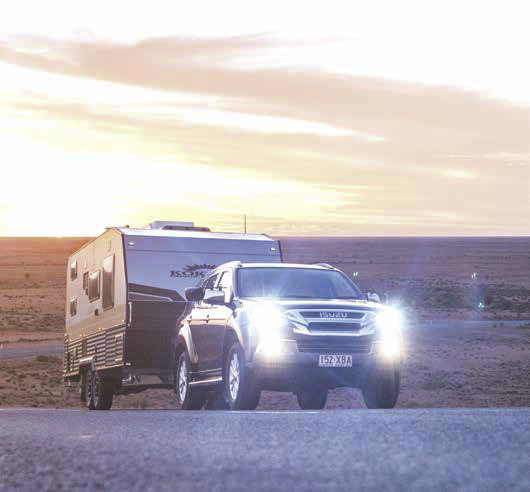
Use your high beams while travelling at night where possible
Early Advantages
Arriving before dark makes it easier to see what you’re doing when you set up camp. Need to find a level site? That’s much easier in daylight. Prefer to avoid tree stumps, picnic tables or rubbish bins when backing in? Same story; they’re much more visible with ample light.
On stormy evenings, would anyone voluntarily park beneath a drought-affected eucalypt? I doubt it. Those overhanging gum tree branches that look ready to drop aren’t called ‘widow makers’ for nothing. And they’re far more visible during daylight hours than they are at night.
If you like socialising, getting into camp early has the added incentive of being on time for Happy Hour drinks, either with people you know or with complete strangers. CMCA RV Parks have Happy Hour shelters to encourage such gatherings.
I don’t know about you, but after I’ve set up camp, I like to wander around to get my bearings. Not only am I looking to see where the toilets and barbecue facilities are located, or what the beach or river is like nearby, but I also do a lap or two of the campgrounds to see who else is around.
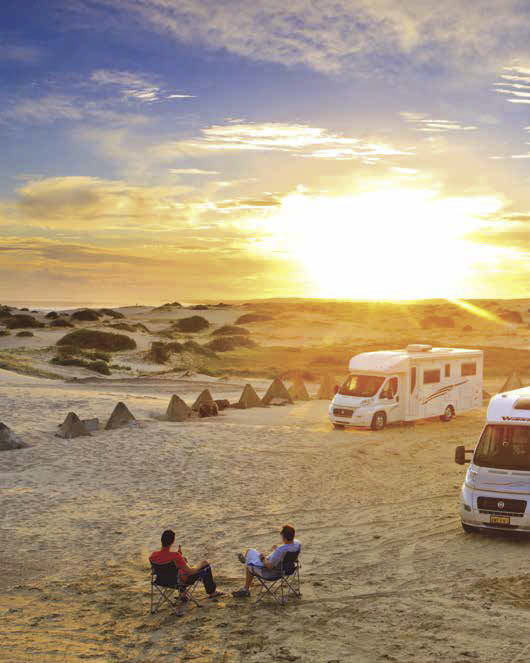
Happy Hour drinks are a benefit of being an early bird
Often, the camping club is a welcoming one. Even if you don’t know anything about your neighbours, you already have something in common. How often have you struck up a conversation with someone you just met then found yourself being invited over for drinks around the campfire?
For me, completing a few laps gives me a chance to check out what everyone else is driving or what accessories they’ve acquired to make life easier. I call it RV envy, and it’s something that I never think I’ll lose. Apart from pining over a few extra comforts that others might have compared to my own set-up, seeing what others do to make life smoother can be educational. If I pluck up the courage to ask them about it, at a minimum I’ll end up learning something new. I might even make a new friend as well.
I’ll give you an example. A few years ago, I saw my first teardrop camper. A middle-aged couple were towing one around the American south-west and I was intrigued enough to go over and ask them about it. I wanted to see how it was designed and how cramped living in one would be. I wanted to know how comfortable it was. At the time, it was a novelty to me. And while some people might have found my intrusion to be a breach of their personal space, this couple were so welcoming and open that they even made me a cup of coffee while we chatted.
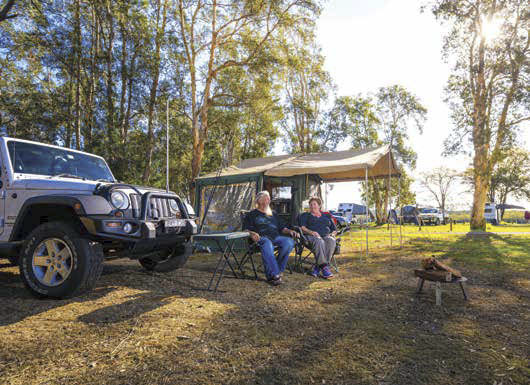
Arriving when there’s light makes it easy to pick a campsite
Consider Wildlife
So, there’s a few reasons for why getting to camp early is a good idea. Now let me offer you a few tips for when you can’t. Driving at night for the first time, or under any different conditions for that matter, can be a little confronting. It requires a lot of concentration.
After two good years of rain in rural areas, it’s likely wildlife populations have boomed, creating increased risks on roads, particularly from larger animals like kangaroos. Kangaroos are more active at night, so you need to be vigilant. During the day, you might not see them; they’re probably resting in shady, forested areas. But night-time is when kangaroos emerge from their daytime hiding places to graze, and those strips beside highways and roads that have been cleared and maintained act as ironclad kangaroo bait.
Roadkill is an indicator that wildlife is around. Hundreds of thousands of years of evolution haven’t taught kangaroos road etiquette yet, and it’s likely that won’t change — at least not in our lifetimes. They tend to stare blankly into the blazing lights of oncoming cars, or they hop out onto the road just as you’re passing.
If you know they’re there, or when you’re travelling along quiet back roads where kangaroos are known to lurk (warning signs usually alert motorists), flick on your high beams (except when it’s unsafe to do so, such as when there are oncoming cars) so your headlight’s arc of illumination broadens; you’re more likely to spot reflecting eyes in the distance. Also ease off on the accelerator to increase your chances of stopping. Ideally, you shouldn’t swerve suddenly either. Try not to panic. Brake gently. And steer slowly and smoothly to avoid losing control.
While the general rule is to remain in the left-hand lane unless you’re passing another vehicle, in rare cases it’s safer to break that rule. I clearly remember a time when I had to do exactly that, during a night time commute up the Hume Highway to the snowfields. Dozens of healthy-looking kangaroos were grazing so close to the highway where it crosses the Great Dividing Range near Broadford that I felt safer being further away from them in the right-hand lane.
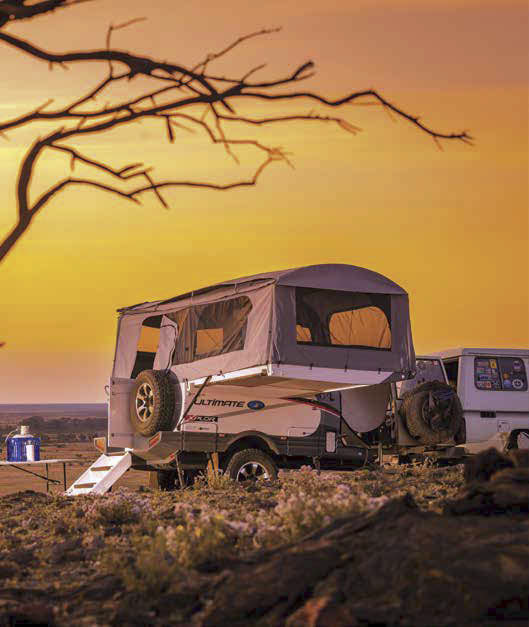
Take these tips on board and you’ll be camping in no time
Light Thinking
Speaking of lights, don’t forget to turn them on at night. A recent NMRA Insurance study found that 14 per cent of motorists driving after sunset failed to turn their headlights on, increasing the risk of collision. The insurance group’s research revealed that the daily average number of motor collisions doubled between 3pm and 6pm, and that risk increased with low visibility. More than 1,500 vehicles were filmed on a busy Sydney arterial road during peak hour in low light, showing more than one in ten vehicles without their lights on.
Some other tips regarding lights:
- Dip your lights for oncoming cars, or when following other cars.
- Avoid looking directly into oncoming headlights — they can impair your vision. If you can’t see properly, slow down or stop.
- If relevant, check the position of your rear-vision mirror. Adjust it to the night driving setting to avoid being blinded by the lights of vehicles travelling behind you.
- Use your fog lights or headlights on low beam in foggy conditions. Light can reflect off the fog, so using high beams in fog makes visibility worse.
- If fog or rain is extremely heavy, you can drive with your hazard lights on to make sure you’re visible to other road users.
- In poor weather conditions, like fog or heavy rain, follow road markings on the side of the road. If the rain gets too heavy or the fog too thick, pull over until you feel comfortable enough to keep going.
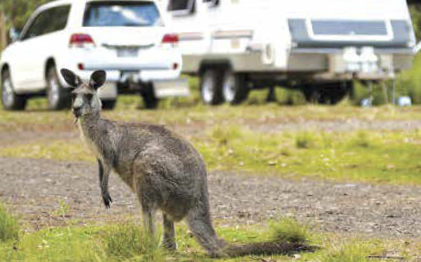
Wildlife is more active at dusk and night-time
Common Sense
If you want to simplify things, night driving just requires a healthy dose of common sense. Other things to think about are:
- Keep your eyes trained on what is happening around you. Try not to focus your vision on one point for too long.
- Limit distractions. Resist the urge to use your phone when you’re driving. Loud music or friends can also be a distraction.
- If you have a long night drive ahead, plan stops along the way.
- If you feel tired at all, pull over and stop the car. Consider sleeping somewhere for the night. You’ve carted along the hardware for it, after all, so there’s no excuses.
- Increase the gap between you and the vehicle in front of you. In the event of an accident, it will give you more time to stop.
- Lastly, there is no shame in choosing not to drive in conditions that make you uncomfortable or nervous.