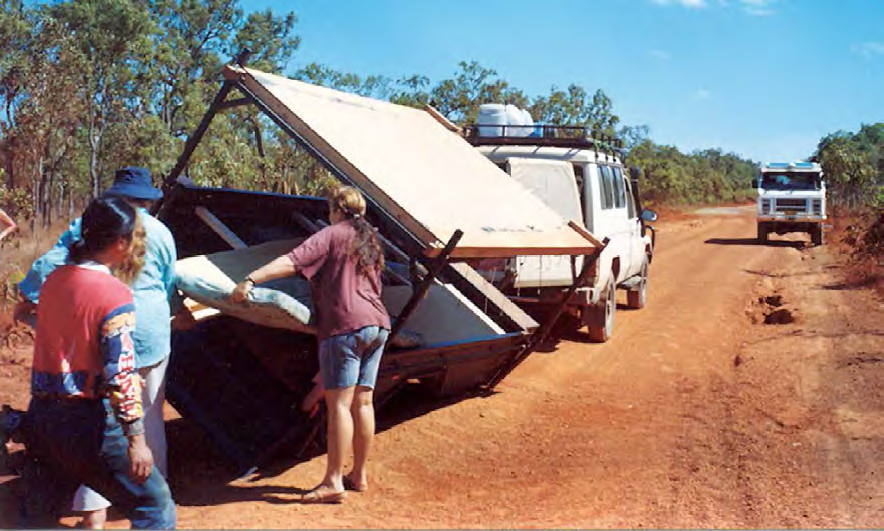
While many blame Sod’s Law, there are logical reasons why and how threaded fasteners, including wheel nuts, loosen and/or break.
The threaded section of screws is by necessity spiral. One side of a tightened nut pushes up on one side of the thread. The other side pushes down on the other side of that thread. Slight clearance must exist to enable the nut to turn but tightening normally holds these faces in contact. It also prevents sideways movement.
As the threaded fastening is tightened it stretches slightly – marginally reducing its diameter and increasing inter-thread clearance. Repetitive side loads including bending, may cause the nut or stud to move slightly from side to side, momentarily reducing friction between the threads. This slightly relieves the tension in the stretched fastening – acting much like a ratchet mechanism. It not just allows, but actually causes nuts and studs to undo.
Prove this yourself! Hold a large diameter, clean threaded stud and nut vertically and shake it vigorously from side to side. The nut will unwind. Much the same happens with a screw fastening under tension. If repeated sideways movement exists, nuts and studs literally ratchet themselves undone.
By further adding elasticity, spring washers, installed to ensure tight stays tight, may make matters worse; in contrast, Nylok nuts usefully add friction and marginally limit side movement.
Castellated nuts and split pins work well, but complicate tightening and re-torqueing as new holes may be required.
Double lock nuts help because the upper nut is freer of loosening forces. Left-hand threads are sometimes used on left side wheels (mainly on trucks and older cars) as right-hand threads on left side wheels may have their retaining nuts work loose.
By reducing side movement Nylok nuts are a partial solution – but eliminating inter-thread gaps between threads results in far less likelihood of nuts undoing. This is how Loctite and similar liquid products work. They do not ‘glue’ things together but, by filling the gaps between threads, virtually preclude loosening.
No such product is truly suitable for wheel nuts, wheel studs and U-bolts that tend to ‘bed down’. They may need initial re-torquing, but doing so destroys the effect of any gap filling product.
Loctite 290 partially assists. It is applied only after final re-torquing, and works its way even between horizontal threads. U-bolts may need initial re-torquing but any subsequent need is usually due to poor initial design.
Correct torquing of wheel nuts and studs is essential. Insist that final tightening be done to the vehicle maker’s specifications. Never allow a ‘rattle gun’ be used for tightening; nor allow a tyre fitter to do it by ‘feel’. Many insist they can ‘feel’ correct tension but research by General Motors found over half of 300 experienced tyre fitters unable to ‘feel’ specified wheel nut tightness by +/- 30 per cent. Some were over +/- 40 per cent. Worse, individual’s results varied throughout the day. Consider having your own high quality torque wrench and insisting on doing the final tightening yourself. Tyre fitters rarely object as it relieves them of the responsibility.
REDUCING LOOSENING FORCES
A further way of reducing loosening is to reduce enabling forces such as side shock loads, eg., repeated bending and repeated heating and cooling. Vibration alone may not cause a nut to loosen unless also subject to side forces.
WHY WHEELS FALL OFF
Despite outback Australia being littered by broken axled trailers, but rarely by whatever tows them, their makers may still deny there’s anything wrong with their products. But what almost all such failures have in common is lack of shock absorbers, or even provision for them.
Here’s why they are needed. As a wheel traverses a bump, it is driven sharply upward, compressing the leaf spring in so doing. Interleave friction absorbs a small part of the energy, but only on the upward travel. As the wheel begins to descend, the pent-up energy in the now virtually unrestrained spring leaves hurls the road wheel downward like a jackhammer.
The resultant shock load as the wheel strikes the road is via the wheel studs. Conically faced wheel nuts and locations limit the movement, but the high and repetitive forces cause slight sideways movement that further causes (not just allows) wheel nuts and studs to loosen.
Corrugations repeat the above roughly 700 times per kilometre: even a few hundred kilometres may cause a nut to ratchet off. Others may work loose and then bind: the studs are then abraded – worn by friction – until they shear.
THE ACTION OF SHOCK ABSORBERS
While at Vauxhall/Bedford Research, I devised a test rig that simulated bump action on damped and undamped axles. I later logged the shock loadings on a leaf-sprung QLR Bedford driven twice across Africa. The difference in shock loading on rebound between a damped and a briefly undamped rear spring averaged about 35 times greater. See www.caravanandmotorhomebooks.com/driving-across-central-africa for more information.
OTHER SPRINGS
Coil springs have close to zero self-damping and are never used without shock absorbers. As rubber is partially self-damping, Al-Ko rubber spring assemblies are available with and without shock absorbers. Curiously, in Europe where roads are generally better than ours, most Al-Ko rubber-suspended caravans have shock absorbers as standard.
Shock absorbers control both bound (compression) and rebound movement. They dissipate imparted energy as heat. Once such action and effect is understood, the need for shock absorbers is obvious. The only exception is where the springs are so stiff there’s little spring movement to dampen: wheel studs and stub axles merely snap instead.
If a trailer builder tells you that shock absorbers aren’t needed, ask why his/her products are immune to the fundamental laws of motion.
Several research papers describe fastening behavior in rigour and detail (eg., Girard S. Havil), ‘Designing with Threaded Fasteners’, Mech. Eng., Vol. 105, No. 10, Oct 1983.
Collyn’s books on aspects of RVs (and also solar) are available (postfree) directly from CMCA NHQ. They are also available from www.caravanandmotorhomebooks.com –postage is applicable.