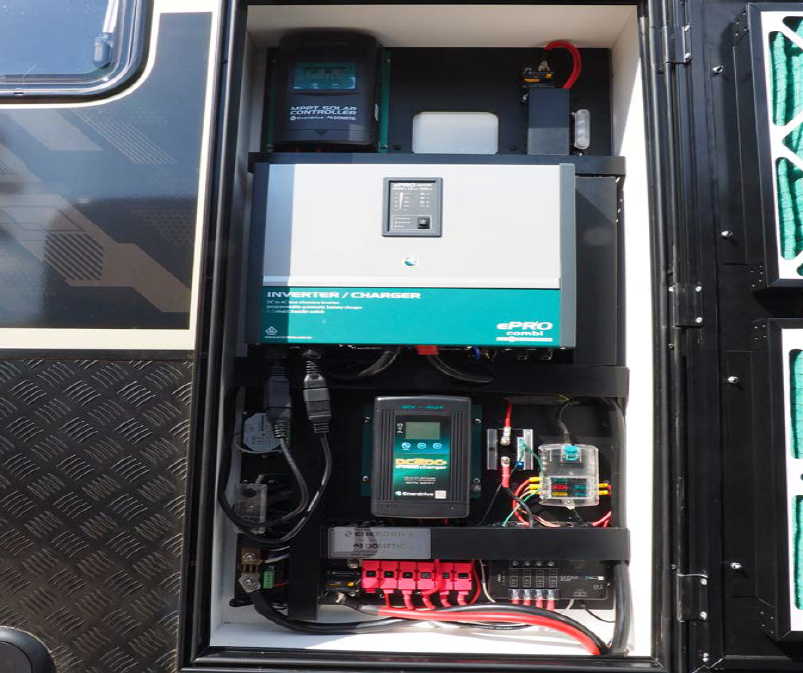
An inverter is an electronic device that converts low-voltage DC (12V in our case) to 240V AC.
Inverters have been on my mind lately, mostly since I attended the National Rally in Dalby in October 2023. I was staying in a rental motorhome and on an unpowered site. Naturally, my motorhome did not have a fixed inverter and I had a laptop and a couple of camera battery chargers that required 240V.
An inverter, for those who don’t know, is an electronic device that converts low-voltage DC (12V in our case) to 240V AC. It’s not a transformer, which converts one AC voltage to another; neither is it a rectifier, which converts an AC voltage to a DC voltage.
There are three types of inverters. The simplest and cheapest produces a square wave which really isn’t suitable for many applications, including use in recreational vehicles. Next in price and complexity is a modified sine wave inverter, which, if you look at it on an oscilloscope, produces a waveform that is stepped rather than smooth. It’s okay to use on most electronic equipment but not all. The best (and most expensive) inverter is one that replicates a true sine wave. It can be used to supply medical equipment, sound systems, laser printers and AC motors.
Which brings me to my little problem. I own a couple of inverters that plug into a cigarette lighter socket. One, a pure sine wave model rated at 150W and the other, a modified sine wave unit rated at 200W that I unintentionally acquired. I’d rather use the higher-rated inverter but have some concerns about the modified sine wave. As noted above, it works for many devices but not all. Of particular interest to me is my laptop computer charger and its suitability for use with a modified sine wave inverter.

As with any 240V AC systems, all work should be done by appropriately licenced persons.
Internet research on the latter produced various conclusions, not necessarily helpful. I consulted David Bayliss at BMPRO, an RV power management specialist manufacturer. His opinion was that whilst modified sine wave inverters should be okay in most cases (near 80%), there are some where they are not. I’ve decided to choose discretion and use the pure sine wave inverter.
When I was checking this little matter out, I discovered that there are portable pure sine wave inverters available up to a rating of about 300W. Above that, fixed inverters are hard-wired to give the necessary current capacity and minimise voltage drop. The problem with the 300W rating is at 12V it requires a current of 25A. It’s quite substantial for a 12V socket, aka cigarette lighter plug.
That’s something of a legacy from a historic car accessory that’s no longer used but is still with us because there are any number of devices that can be run off 12V in a car. The problem with the conventional 12V plug is that it’s not really rated for higher current devices and can cause voltage drop issues.
Even a 150W inverter is borderline. Better solutions than the conventional cigarette lighter plug are either a Merit plug or an Anderson Plug, which of course, most vehicles don’t have as a standard item. The Merit plug looks a bit like a standard 12V plug but is physically smaller and has a better current rating. Anderson Plugs are commonly used for connecting a tow vehicle and RV and as a high-current connection for portable solar panels. On some installations, a polarised low-voltage plug and socket are used. That looks much like a domestic plug and socket but the two pins are at right angles to each other.

Inverters have very much become a part of many high-capacity RV power system battery systems. Even though they are powered by low voltage 12V DC, the 240V business end should be treated with the same care and attention as any other 240V AC installations. Under the recent changes to the electrical standard AS/NZS 3001 2, all fixed inverters in any RV are now required to have a separate Residual Current Device (RCD) as standard. RCDs are designed to immediately switch off the power in the event of an earth fault, i.e. someone coming into contact with a live conductor.
An inverter is a useful device, but as always with any electrical item, research before purchase is always a good idea, particularly on anticipated loads. The 240V power load for a laptop charger is vastly different to, say, a microwave oven. Any fixed connections on the 240V side should always be done by a licenced person.