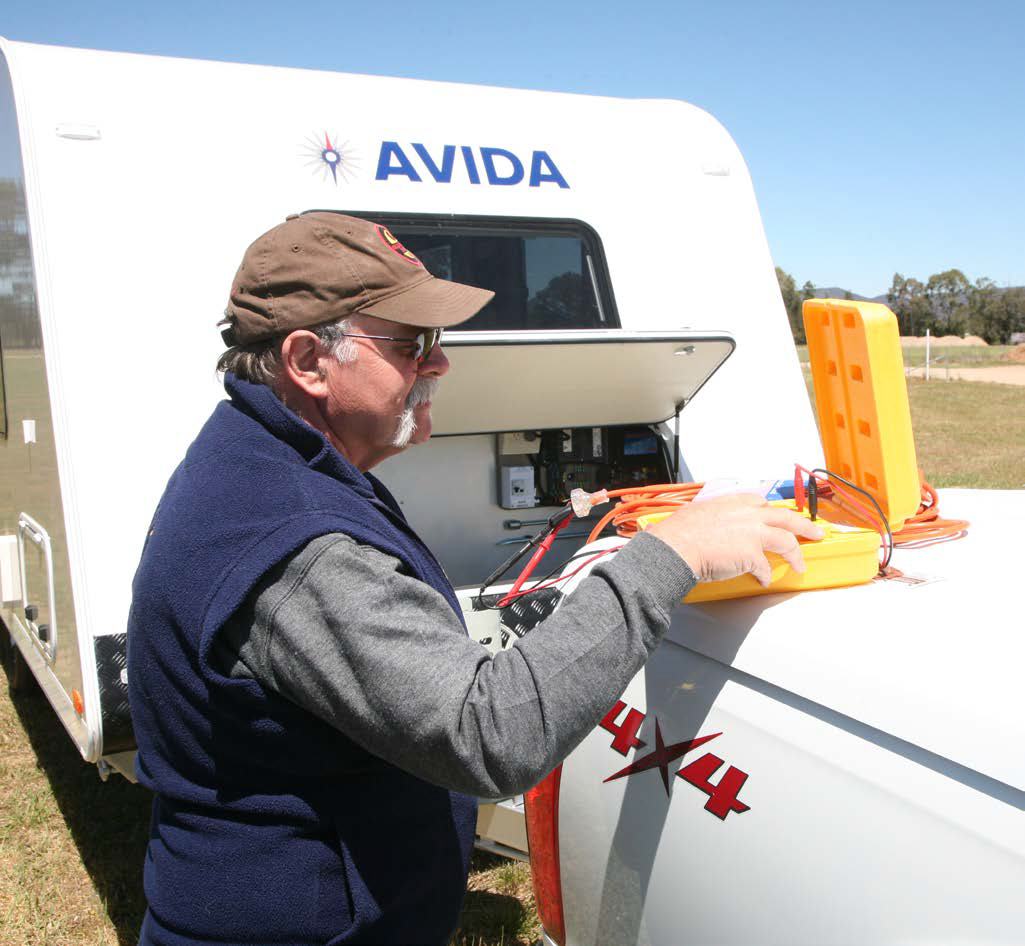
Following my column on inverters, I received a question on conducting system checks using a digital multimeter. Power systems in motorhomes and caravans have become very sophisticated, particularly with the rise in usage of lithium FePO4 batteries. If there’s a fault, some contemporary systems are sophisticated enough to be self-diagnosing; but most require old-fashioned testing. Although many power systems look mind-boggling, a little knowledge and the right test gear can often resolve a problem.
Caveat: A little bit of knowledge is essential, and whilst work can be undertaken on 12V DC power systems, a licensed person should do any required repair work on 240V AC systems. Care should always be taken when testing vehicle or house batteries to ensure that metal tools are not accidentally dropped across battery terminals, or between the positive terminal and vehicle body.
Test Lamps
On 12V systems, the most straightforward test device available is a 12V test lamp. Available on eBay and at any car accessory store, these can be used to check for 12V on any circuit and are particularly useful for testing for blown fuses and the plug and socket connections between caravan and tow vehicle – often problematic because of how that connection gets used and abused. I have a similar device for 240V circuits, made (I suspect) long ago by a (before privatisation) County Council apprentice. Another testing device I own is a noncontact voltage tester. Like a fat pen, it’s designed to test something like dodgy caravan park sockets where the insulation isn’t quite what it should be … what the Americans call ‘hot skin’.
Multimeters
The problem with all those (above mentioned) devices is that they can only test for live voltage or no voltage and not much else, not even a voltage drop problem. A better solution is a digital multimeter. A digital multimeter in the right hands is a handy tool that is relatively inexpensive.
Some digital multimeters can be quite confusing to the uninitiated. But for our purposes, the requirements are pretty simple. A multimeter should at least have an ohm (represented by the O symbol) scale, an AC voltage scale (represented by a V with a squiggly line) and a DC voltage scale (represented by a V with a straight or dashed line). An alternative to the DC scale can be a battery tester with voltage settings like 1.5V, 6V, 9V and 12V. Sometimes the ohm scale also has a diode symbol (sideways cross with a superimposed triangle) or a buzzer symbol.
For all of the above, the range has to be set on some multimeters, i.e. 200O, 240VAC and 12VDC, but other (usually more expensive) multimeters have an autoranging feature that just requires the scale to be set.
The multimeter leads are usually plugged into the common (black lead) socket and the VO (red lead) socket.

Circuit Testing - Ohm Scale
The ohm scale on multimeters is typically used for testing resistance and resistors. However, for our purposes, it’s better used for circuit testing and the range to choose for that is either 0O or the diode/buzzer symbol. Note for any testing using this range, all power must be off. For example, let’s assume one of the conductors in a standard caravan power lead is suspected to be open circuit. With the power lead unplugged and a meter probe at each end of the cable, checking the connections of the active, neutral and earthing conductors is simple. The plug, socket or cable may be a problem. It’s a technique that can also be used on a caravan to check connections between the trailer plug and the lights or other devices. Some years ago, I discovered a 12V negative lead that had come adrift from a motorhome battery connection by doing a simple circuit check.
12VDC and 240VAC Testing
Since 12VDC power systems have become prolific, multimeters are particularly useful for checking for voltage drop/bad joint problems. For voltage checks, choosing the right range is essential so that the multimeter will read correctly.
Unless using an auto-ranging multimeter, there won’t be an exact match to the supply voltage – so something higher than the voltage being tested will be fine. Typically, 2VDC is used for AA batteries, 20VDC is used for 12VDC systems, and 600VAC is used for 240VAC installations.

Which Multimeter?
For those who don’t own a digital multimeter, a purchase can be a bewildering choice. Prices can start from $15 and run to $1,500. I have two multimeters – a small pocket one that does the basics when travelling by air, and a larger model for home/workshop use. It does depend very much on how much of a technical background the user has but I’d recommend avoiding the $15 models and buying something with a price tag of at least between $60 and $100. That should cover most electrical situations in the world of motorhomes and caravans.