What Amber Learned from Five Months on the Road
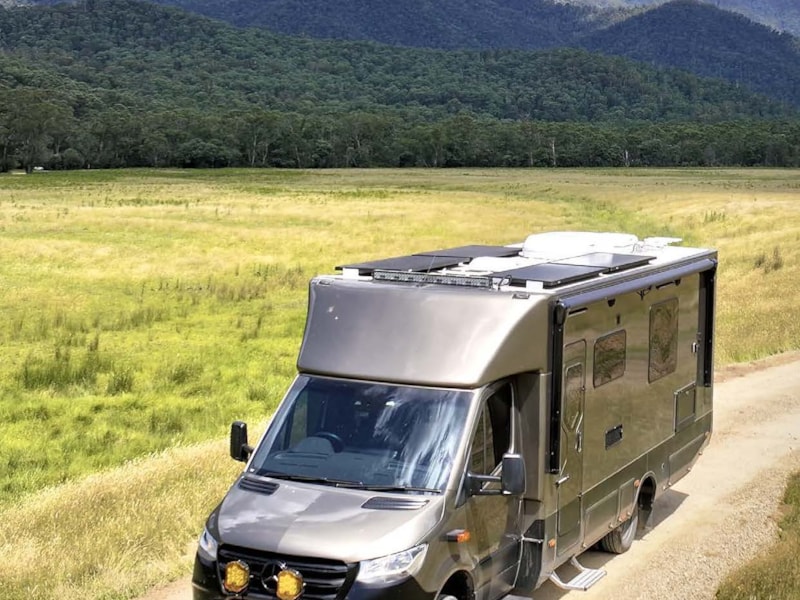
Bendigo-based Amber Tierney spent five months living and working on the road in her RV with her husband Nick and their two dogs. The couple sets off again in March – this time with their newborn baby girl, Indiana. Here are their top tips for first-timers who might also want to find work while on the road.
Have a routine
When we are travelling, we need a routine, because if we don't have one, it just becomes this big holiday – you're eating and you're drinking and you're doing all those things, and you're not super worried about it. Getting up between seven and eight o'clock is probably the biggest thing that we had to learn to do. So we wake up in the mornings, make a coffee, then start our day from there.

The best office view you'll ever have — morning coffee in the van while the surf rolls in.
If you want to find work, there is work out there
Don't be afraid to put yourself out there. On our last trip, we found that people had advertisements in their windows because they're looking for people who want to work. You might not find it as much on the East Coast, but you'll definitely find work in the country, outback areas.
Use dedicated ‘work finding’ pages on Facebook
When it comes to working on the road, you’ll find most of your work on Facebook. The page we use is called Working on the Road in Australia. My husband's a truck driver, and he's also a furniture removalist, so there are always options for him to find work along the way. You can pop an ad on them when you know you’re going to be in an area at a certain time. They’re screaming out for workers in the Darwin, Kunnanurra and Broome areas.
I also work online creating UGC, and I’m an ambassador for Crusader Caravans. On the next journey, I’ll be working for brands in online admin roles.
What we look for are jobs that provide a place for our RV. So that means that Indy, the dogs, and I can be there while Nick is out working, and I can do work from my laptop.
Get a Starlink satellite
Our first half lap was for five months, and we didn't take anything but our phones. I'm with Optus, and I barely got reception for the majority of the trip. Nick was with Telstra. He got reception three-quarters of the time. We've just ordered Starlink for our next trip purely because, having a baby, I don't ever want to be in a situation where I need to call for help and I can't. Starlink is also great for working on the road, finding campsites and checking maps. Having the Starlink mini on top of the Land Cruiser means that I can search for things as we're travelling, no matter where we are.

Emergency Apps are important
There's a free app called Emergency Plus, and if you download that app, it'll allow you to call 000, the SES and the police, no matter where you are, using a satellite from your iPhone.
It also gives you a latitude and a longitude of where you are. So if you're stuck somewhere, on a hike in the middle of nowhere, it will give you the coordinate details to get help.
Make sure you’re somewhere you can get reception
If you're at a campsite where there's beautiful tree coverage, you're probably not going to get reception. You need to be somewhere where you can see the sky. So if there's an opening in the middle and there are trees all around, that's fine. As long as there's an opening in the middle, that's where your Starlink has to go. Our Starlink is on our car, so we can unhitch the van and park in an open space if we need to.
Don't book ahead unless it's school holidays
We booked ahead on our first trip. We got to one place and loved it, but we couldn't stay there for longer because we were chasing our bookings.
Outside of the school holidays, it’s usually easy to find places to camp.
Make sure you have a decent amount of money saved before you set off
We have a 20-something-year-old car, so we need to be able to service it. Even though you will find work on the road, having a safety net of funds is a good idea in case something goes wrong.