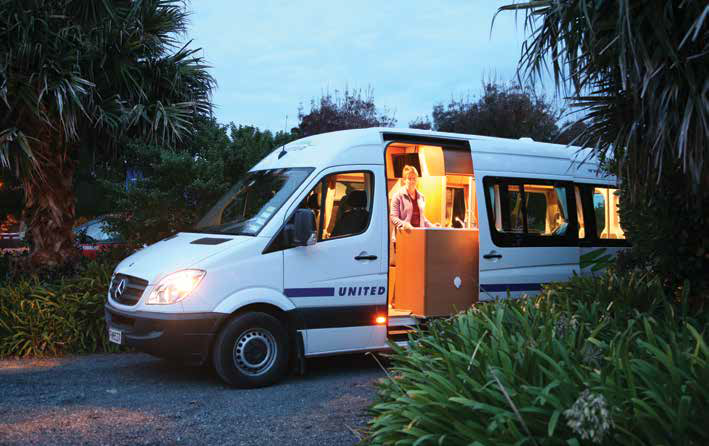
As you might have read elsewhere in this fine publication, I recently attended the National Rally at Gunnedah. For the duration of the rally I was staying on an unpowered site, which meant relying on the batteries and solar panels for my power needs, including an 1600W inverter. At one point I used the coffee machine a bit too often, with the end result being a flat house battery overnight.
Some months ago I was in New Zealand travelling around in a motorhome and doing a bit of freedom camping. Although I was much more cautious with my battery use – no coffee machines, just a bit of device charging and mostly fridge use – I still managed an overnight flat battery. On both occasions, the problem was rectified when I fired up the vehicle engine and drove off. I suspect in NZ the battery was reaching the end of its effective life.
All of which had me thinking about battery and charger systems because regularly flattening a house battery is not a good thing. Although lithium (LiFePO4) batteries do much better in terms of lifespan, deep cycle batteries can have a much longer life if they are maintained at about 50 per cent or higher of their charged capacity.
About 10 years ago battery systems were relatively simple – there was one single house battery used to power lighting, a water pump and maybe a fridge. There has been much change since then, with the addition of solar panels, high powered inverters and generators being used to power considerably higher 12V loads (except for the case of LED lighting which has reduced power requirements).
Frequently these days battery capacity is 200AH and there is also an increased use of lithium battery systems.
There has been one other significant change in recent times – instead of just a multi-stage charger, now battery management systems are employed to monitor not only mains charger or vehicle alternator input, but also sources like solar panels and portable generators, thus ensuring batteries are charged with maximum efficiency. Apart from anything else, it’s relatively easy to regularly monitor battery condition.
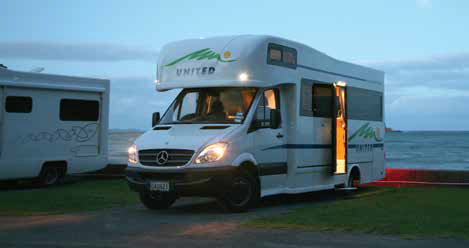
Waking up to a dead battery is never a good thing
The question that occupies the mind of quite a few prospective motorhomers is just how much battery and solar panel capacity is needed. That can be answered by calculation, although there are a few ins and outs to be remembered. For instance, most power devices are rated in terms of Watts, so a typical fridge might draw 100W when operating. However, an 800W microwave is measured in terms of how much heat it produces, so the actual power it uses might be up to 1300W. Also battery losses when charging/discharging can be quite high – around 15 per cent for all lead acid batteries and about half that for lithium batteries.
Very briefly, a rough solar panel capacity can be figured by tabling all your devices and their power rating, and then the amount of time they are used each day. That will give a Watt hours per day figure – don’t forget to factor in the 15% loss figure. That will give the amount of energy that the solar panels need in order to recharge the batteries. Below are a few typical examples of power requirements.

You might have noticed that I used Watts for solar panel calculations but batteries have an Amp Hour (AH) rating. Simplifying things, that roughly means a 100AH battery can deliver 100A for one hour, or 10A for 10 hours. However, that is dependent on a number of factors and not quite that simple in the real world.
The relationship between power and current uses quite a simple calculation – Power (P) is a factor of voltage (V) times current (I) , ie P=V x I. Again, simplifying things – let’s say we have a 120W device and need to know the running current then 120W divided by the Voltage (12V) gives us a 10A running current. Doing a calculation on how much current each device draws and how long it’s likely to operate for will give an Amp Hour figure that can be used to get an idea of battery AH requirements.

Battery packs can be housed in a slide-out configuration
I stress all of the above is quite simplified, and it’s worth finding out more at: www.rvbooks.com.au. Author Collyn Rivers also publishes a number of helpful, highly detailed books on the subject.
Most of the above takes no account of energy losses in any system, which usually occurs in the form of heat. Transformers get hot, pumps get hot, and sometimes even cables get warmer than they should. There are ways to minimise this, such getting cable sizes correct. Devices like inverters which convert 12V DC to 240V AC mains power do have a degree of energy loss (mostly through heat). Where possible, it is better to have devices that run straight off 12V DC or can be charged from purpose-fitted 5V USB outlets.
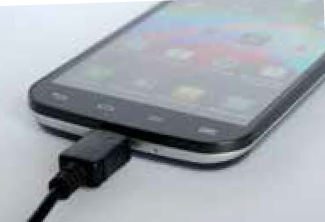
Mobile phones can be charged straight off 12V DC
Timing could be a factor too. We all have multiple personal devices these days. Charging them while travelling along may well save a few Amp Hours as opposed to when parked overnight. For this reason, I have several sets of leads bound together that I carry around when travelling. All have the necessary connections for the devices and they can be charged up any time I am driving.
The above briefly covers the subject of avoiding a flat battery – more could be written but there are times when it comes down to nothing more than switching things off when not in use and maybe turning down the fridge thermostat overnight.