Around the country there are any number of locations that have a strong connection to Australia’s settlement history. In some cases all the evidence has disappeared but in others a little bit of detective work will reveal fascinating gems from times past.
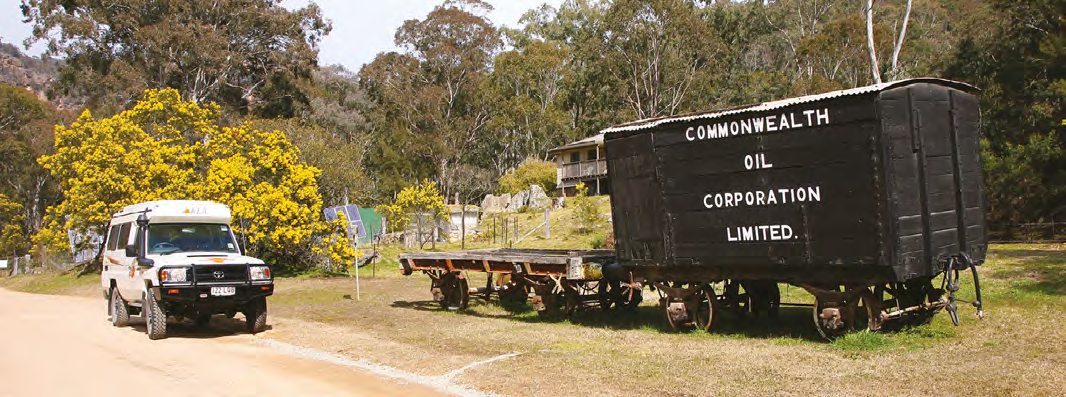
One of the little secrets of Australia’s past mining/industrial history has to do with shale oil mining. Not to be confused with the current controversial practice of fracking, Australia’s early shale oil industry was mostly situated around the Sydney Basin during the latter half of the 19th and the early part of the 20th Century.
While much of the mining activity occurred west of the Blue Mountains in places like Hartley Vale, Torbane, Newnes and Glen Davis, there were other locations like Joadja in the Southern Highlands that were profitable mining ventures for a number of years.
Such was the level of mining activity that, in addition to entire towns, a number of comprehensive railway systems were also established. The reason for the towns was in part because of the mine’s remote location but also that in order to produce the shale oil, a substantial amount of industrial infrastructure was needed to support the operations.
To produce shale oil, a process known as pyrolysis had to take place. Just in case you are not familiar with that word, it means that the shale had to be heated in purpose built retorts. When a sufficiently high temperature was reached, the shale gave off a vapour which was subsequently cooled in condensers to produce the oil. This was then used for kerosene, lamp oil and paraffin wax. There were a few by-products too; one being something we know today as petrol.
Today, most of the evidence of this mining industry and related railway transport has disappeared. However, in at least two places, Joadja (near Mittagong) and Newnes (near Lithgow) there are enough remnants left to make visits worthwhile.
In its heyday, during the late 1800s, Joadja had a population of around 1200 people, something that is hard to believe on a site visit today. Much of the population consisted of Scottish immigrants who were employed because of their skills with shale oil mining. They, of course, have long gone but their heritage remains in a number of places within the Southern Highlands area.
Today, Joadja is on private property not far from the Wombeyan Caves Road. There are a number of ruins to be seen. Some, like the retorts, where there’s enough structure left that it does not require too much imagination while others are just piles of bricks. The current owners are doing much to preserve what is left and have even extracted heritage money from the Federal Government to partly restore buildings like the Carrington Row cottages.
Currently Joadja is only open for visitors on selected Sundays, so a check on access dates is essential. In addition, though, groups (think: your chapter) can arrange a private visit and an overnight stay but that has to be booked in advance – don’t just turn up. One of the recommended activities is the guided tour which gives a very good insight into Joadja’s history and also a look over the modern-day whisky distillery. You could also introduce yourself to the resident Highland cattle. See www.joadjatown.com.au for more details.
Somewhat differently, Newnes is located within the Wollemi National Park and is accessible at all times. Being a later development (early 1900s) but with a smaller population (max 800), there are more ruins at Newnes than Joadja. Little attempt has been made at preservation and much of the area has been taken over by the bush. It’s quite fascinating to see what happens when nature takes over.
There are plenty of camping areas at Newnes and there is but one liveable building – what used to be the old pub. It’s now just called Kiosk and while open at weekends is not usually so during the week. Around the Newnes area there are plenty of bushwalking opportunities and that includes the famous glow worm tunnels which are accessible from either Newnes or from the Lithgow/Zig Zag Railway end along the bed of the former railway track – a torch is essential.
Anyone who has been to Newnes in past years will recall the poor state of the road beyond Lidsdale. However, since the construction of the Emirates Resort, the road at least to the resort turn-off hasbeen much improved. (See http://users.tpg.com.au/newnes for more details.)
At Newnes and, to a lesser extent, Joadja, there are other things to do than just wander around looking at old ruins – think bushwalking, mountain biking, birdwatching and photography. Both places give a fascinating glance into a small part of Australia’s history and both are accessible by motorhome.