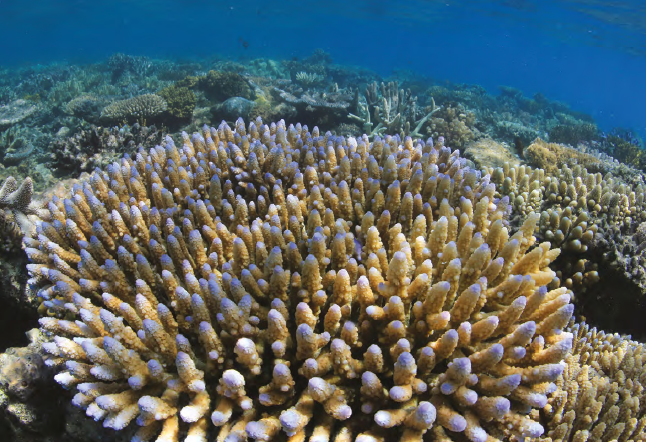
The thing I love most about trolling up North is that it’s pretty much a lucky dip. Working the reef edges you can hook everything from coral trout to barracuda, GTs to mackerel – you just don’t know what you’re going to connect to next.
Tropical waters really are a predatory environment and a helpless lure wiggling along is just asking to be eaten. However, as rich as life is in the tropics the waters aren’t always teeming with fish life so you need to concentrate your efforts on specific areas to get the best results.
NOT ALL STRUCTURE IS EQUAL
Obviously, the key is to fish where the fish are. It doesn’t matter how hard you fish if you are not getting your lures under their noses then you’re not in the running. Now, most anglers know they need to focus around structure, but we need to be more specific than that. In the tropics there is heaps of structure, especially around coral reefs so finding the fish is far more complex than just trolling any reef edge. What we need to add into the mix is current – as they say, if there is no run then there is no fun.
Locating vertical structure is only part of the equation. In many areas there are incredibly extensive reef edges; a classic example is the Great Barrier Reef. Here, reef edges stretch for hundreds of miles and, while they may look good, believe me there is a lot of dead water along the way.
Again, current is the key. Look for areas where there is an abnormality, like an isolated bommie jutting out at right angles from the main ledge or ridge line. The key is that these and similar types of structure are disrupting the main current flow to create an upwelling. This makes a great place for bait to feed as well as an ideal hunting ground for predators.
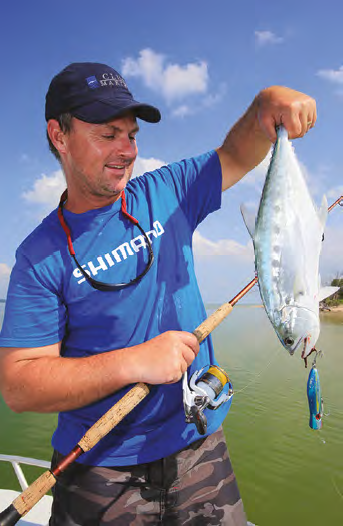
Queenfish are suckers for surface lures
TROLLING TRICKS
The trick to tropical trolling is to set up your spread of lures so that you can cover as much of the water column as possible. The biggest mistake many anglers make when fishing in the tropics is to be content to catch a few fish. Yes, there is no doubt that you will catch something by simply trolling around, but if you put a bit of forethought into setting up your spread then you will quickly improve your odds and come home with bigger and better fish.
The first lure, which is run in tight closets, is a mega deep diver, such as the ever-productive Scorpion Crazy Deep. This lure quickly dives down to its running depth and as a result can be towed on a relatively short leash. This is important when you have to wrestle away from the reef whatever eats it. In most situations I set the deep diver just 20 metres back. When fishing right in tight against the ledge I run it on the outside, away from the reef edge, to minimise the chances of snagging. Being the deepest lure in the spread this lure often picks up bottom dwellers like coral trout, but it also picks up a lot of crap fish as well.
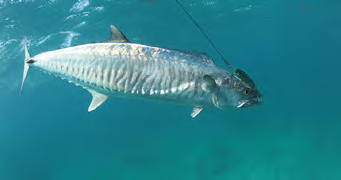
Spanish mackerel favour the reef edge and love fast trolled lures
Behind the deep diver, maybe 25 to 30 metres back, is where I like to run the shallow divers like the Laser Pros. When it comes to colour, metallic silver and purple is always at the top of my list. Fish this lure in the opposite corner to the mega deep diver to minimise tangles as well as a allowing you to do some really tight turns.
The popper holds the last position in the spread. Sitting all by itself this lure is highly effective and produces some good fish. If you are fishing in an area where there is a chance of billfish then it can be a wise decision to opt for a skirted lure like a jethead instead.
Although relatively basic, the spread that I have outlined here can here be used effectively on a wide range of species. Obviously a few minor variations may have to be made to suit different locations, but it is a good base model to work with irrespective of where you fish throughout the tropics.
TROPICAL DELIGHTS
Tropical trolling is a lot of fun and highly productive. Make the time to research your area and really identify the hotspots where currents and structures meet. The lure spread I have highlighted here is universally effective on reef edges from Broom to Gladstone. The best part is that you never know what is going to bite next and that is what makes tropical trolling so exciting.
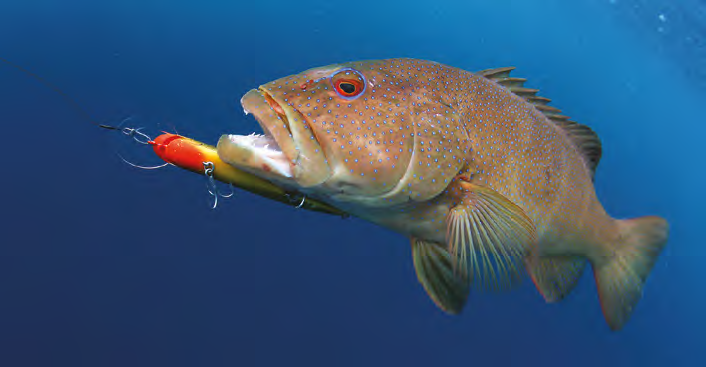
One of the best eating fish in the tropics; coral trout