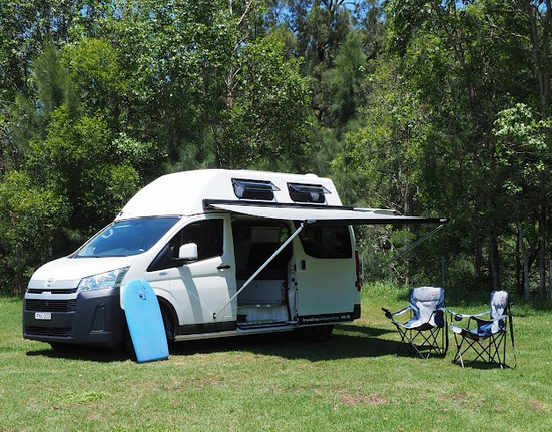
Explore the Frontline Hiace Hi-top camper, ideal for weekend adventures with great features and easy setup.
Hi-top campervans are popular in rental fleets but less so in the retail market, particularly for new models. That’s partly due to practical reasons and some outdated perceptions of what a hi-top camper is all about.
Why Choose the Frontline HiAce Hi-Top Camper for Your Road Trip?
Frontline Camper Conversions is an old-hand campervan manufacturer that uses base vans like the Toyota HiAce, Volkswagen Transport and Renault Trafic. The company specialises mainly in pop-tops but recently produced a model with an optional hi-top. Not long after the hi-top rolled off the production line, Frontline made it available for my use. As someone who has used several pop-tops, I was keen to check out the hi-top.
For my little road test, I decided to find somewhere that wasn’t a caravan park but did offer a few basic facilities, like toilets. Whilst the Frontline Adventurer has most things for camping, it doesn’t have a toilet or porta-potti as a standard feature. I settled on the Bendeela Recreation Area on the Kangaroo River, which is part of the Shoalhaven (NSW) water and pumped storage scheme. Accessible from either Moss Vale in the Southern Highlands or Nowra on the south coast, it’s an area that has plenty of wide-open space for camping, the aforementioned facilities, and river swimming; and it costs a massive $6 per night. That included the wombats that roamed around.
On the road
Bendeela gave me a pleasant place to camp and everything from freeways to winding mountain roads on the way there to test the Toyota out. A 2.8-litre turbo diesel powers the HiAce and, in this case, has a six-speed manual gearbox. Most people prefer an automatic these days, but I still like to use a bit of hand and foot dexterity occasionally and this was an excellent opportunity. The Toyota turbo diesel is a great performer, and I spent a bit of time on the winding Kangaroo Valley Road figuring out which engine revs delivered the best performance in the various gears. At the top end, the freeway is the only place where the sixth gear comes into play; otherwise it doesn’t get used much.
I was keen to check out the hi-top’s effect on vehicle handling, particularly when buffeted by crosswinds. Not much is the short answer; a bigger problem is remembering the vehicle height of 2.6 metres (8ft 6in). Unlike a pop-top, it will be more restricted when entering supermarkets and carparks.

Key Features of the Hi-Top Camper for Light Travel
The Hi-top has a GVM of 3,300 kilograms and a Tare Mass of 2,547 kilograms, giving a payload of 453 kilograms. Something that’s excellent for this sized vehicle and chances are that the available load space is more restrictive than that. The campervan’s length (5.27 metres/17ft 3in) and width (1.95 metres/6ft 5in) are ideal for fitting into most car-sized parking spaces. And even if you can’t open the cab doors, the sliding door is still an option! The standard water tank has a capacity of 40 litres and the optional grey tank, if fitted, is 20 litres.
Efficient Power System for Off-Grid Camping
For the electrics, my review van had a number of options fitted. The original 100Ah AGM battery has been upgraded to a 200Ah Lithium LiFePO4 power supply. In addition, a 170W solar panel and a Victron 2,000W inverter/charger have been included. There’s not going to be a power problem for sure.
Setting Up the Hi-Top Camper: Quick and Easy
Setting up the Hi-top takes minimal time – open the sliding door and wind out the Fiamma F45 awning. A feature I appreciated was the five windows in the roof area. Two on either side and one on the rear wall. They were awning style, too, rather than sliders; which meant they could be left open slightly for rain showers.

Space and Comfort Inside the Hi-Top Camper
Frontline has used its Adventurer layout for this model, which works well. The kitchen bench occupies the offside wall; there’s a seat/bed in the middle section and a shelf area in the rear. The passenger seat swivels around, which is great in the somewhat confined space. The rear seat has seat belts, so two extra passengers can be carried without a problem.
An option for this model is a second bed in the roof area, making it suitable for a family that likes a little lightweight weekend camping. There are no insect screens on either the side or rear doors, but they would be a reasonable consideration for warm days and nights.
Standard on any Frontline campervan is the external shower behind the rear door. It’s cold water unless the optional water heater is fitted, and given the capacity of the water tank, it’s only for a quick shower or foot washing.
Ideal for Light, Weekend Camping Adventures
A camper this size is going to have a minimalist kitchen area. It consists of a bench area with three small drawers and three cupboards. The bench top space is nominal but does include an optional two burner induction hob, a round stainless-steel sink and a 90-litre compressor fridge. For cooking outside, there is a portable butane cooker – the cylinders are stored in an external bin at the nearside rear. A small pole-mounted table is the right height for the seat at dining time. The table and pole are stored behind the driver’s seat when not being used. The table is also designed for outside use.
When the bed is required, the seat folds down easily and, together with the cushion in the rear, forms a 1.83 metre x 1.27 metre (6ft x 4ft 2in) bed. It’s wider in the rear area and creates a comfortable sleeping space.
The rear area is mainly for storage. Under the bed platform, it can be used for items like camping chairs and large plastic containers. A sealed battery box takes part of the space. By day, the bed mattress can also be used for large items. In addition, there’s a small wardrobe on the offside. There’s not much other storage capacity in the van but there is space in the hi-top above the driver’s cab. An optional cargo net would be excellent to have there. The overall storage isn’t excessive, but it’s all designed for lightweight travel.

Bottom Line: A Hi-Top Camper That Offers Convenience and Comfort
There’s little doubt that the advantage of a pop-top campervan is a lower travel height. However, a hi-top takes little time to set up and adds a new dimension regarding head space and extra storage space. In addition, the window area is excellent. The campervan is more a lightweight and/or weekend traveller but certainly has a few advantages over a larger motorhome. For my little jaunt away, it was an enjoyable trip.
Specifications
VEHICLE
MANUFACTURER FRONTLINE
MODEL ADVENTURER HI-TOP
BASE VEHICLE TOYOTA HIACE
TARE WEIGHT 2,547KG
GVM 3,300KG
LICENCE CAR
PASSENGERS 4
MECHANICAL
ENGINE 2.8-LITRE TURBO DIESEL
POWER 130 KW @ 3,400 RPM
TORQUE 420 NM @ 1,400-2,600 RPM
GEAR BOX SIX-SPEED MANUAL
BRAKES VENTILATED DISC
DIMENSIONS
EXTERNAL LENGTH 5.27M (17FT 3IN)
EXTERNAL WIDTH (INCL AWNING) 1.95M (6FT 5IN))
EXTERNAL HEIGHT 2.6M (8FT 6IN)
INTERNAL HEIGHT 1.92M (6FT 4IN)
BED SIZE 1.83M X 1.27M (6FT X 4FT 2IN)
EQUIPMENT
COOK TOP DEVANTI TWO-BURNER INDUCTION HOB
FRIDGE VITRIFRIGO 90-LITRE 12V COMPRESSOR
MICROWAVE OVEN OPT
LIGHTING 12V LED
BATTERIES LITHIUM 200AH
SOLAR PANELS 1 X 170W
AIR CONDITIONER NO
TOILET OPT
SHOWER EXTERIOR, BEHIND REAR DOOR
HOT WATER OPT
HEATER WEBASTO DIESEL
WATER TANK 40 LITRE
GREY TANK OPT – 20 LITRE
GAS CYLINDERS BUTANE FOR PORTABLE HOB
PRICE
$114,110
Supplied by:
Frontline Camper Conversions
36 Cross Street, Brookvale, NSW, 2100
Ph: 02 9939 0600
Web: www.frontlinecamper.com.au