With bitter feelings of disappointment I turned away from the dreary and cheerless place around me.” Edward John Eyre expressed these sentiments in 1840 as he stood on the shore of the lake named after him. I felt the same as I headed towards Marree and then up the Birdsville Track at the start of my three-month winter trip into outback Queensland and South Australia.
As far as the eye could see there was gibber and sand. For kilometre after kilometre stretching to the horizon, all was bleak. There had been no rain for over two years. This is what drought looks like. The only visible wildlife was the wedge-tailed eagle hovering over the carcass of a stray steer. Even that would be slim pickings as many of the stations had been forced to destock.
Yet there is something about this desolate landscape that draws the traveller. Is it the challenge? The primeval struggle, the isolation or the peace? We are not searching desperately for water like the early explorers, we’re no longer trying to forge tracks for cattle for the great musters and we’re not looking for the coast. Yet still we come.

Cuttaburra Crossing on Eyre Creek
I did find oases, though. The Great Artesian Basin, under vast areas of Australia and accessed by bores, has made some of the cattle properties possible, and provided water, and thus a haven, for the outback’s wildlife. Initially this water naturally bubbled to the surface in the form of mound springs and provided a route for the Indigenous to transverse the country.
But foolishness and greed destroyed many of these. Cattle were allowed to tramp and destroy before it was decided to erect fences around them, preventing the cattle access — and sometimes Indigenous access. Then, with European settlement, bores were sunk, windmills were erected, and pipes were laid — lately solar panels have been added to work the pumps. It seems amazing that this underground water — which covers a vast area like a hidden lake — can sustain such life. It can be boiling hot, it can be saline, it can be sulphurous, or it can be pure. Regardless, as it spreads over the surface and rests, it becomes less saline, allowing desert plants to thrive. Insects and birds arrive and an oasis is born. What a miracle! Due to this basin, some outback towns like Bedourie and Boulia have swimming pools and community spas, properties can keep sheep and cattle and mining companies can access water for their recovery processes. The former seems manageable, but with the latter — mining — continually expanding, will the source remain viable? BHP are putting in a bore, which will be their second, out of Marree near Lake Eyre and there’s a newly graded road as the trucks needed to bring in pipes to lay from there to Roxby Downs. The water basin at Marree has dropped eight metres in a mere hundred or so years — not long in this timeless land. And let’s not forget the potential for destruction by the Adani water licence, and fracking across the country — we don’t know what the outcome and impacts of these bores could be.
The bore pipe at Mungerannie Pub was capped for a while, as water was needed for cattle rather than the wetlands and it’s not an endless source. But it is now incredibly sulphurous as it comes through the pipe. The wetlands will recover over time as this water sits, filters and fills the lagoon. The bores at Muloorina, out of Marree, and Gilmour Creek, by old Cacoory Station below Bedourie, provide wonderful wetlands and a sanctuary for all kinds of life.
However, bore water cannot be accessed everywhere. Some is so deep below the surface that the area must wait for rain.

The Darling River in Karoola Station
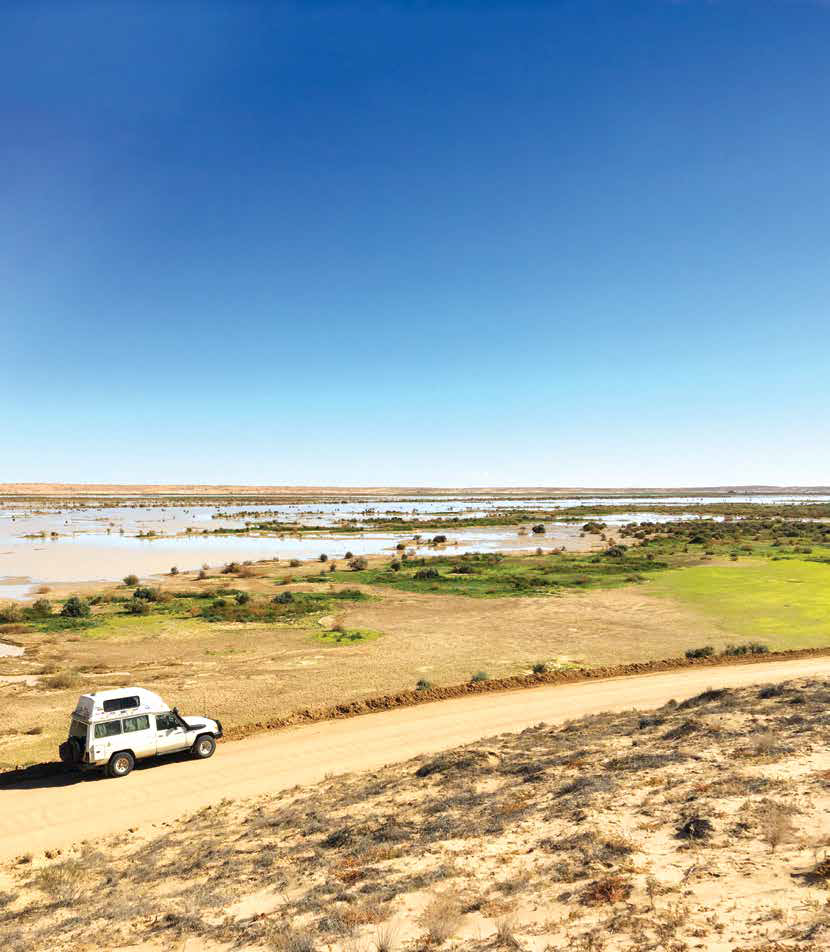
But the country can provide another miracle. When it rains in the north during the cyclone season this rain can head down the arterial rivers, into creeks and over the plains to areas far south. The devastating floods around Townsville in February and March 2019 provided a life source for towns like Birdsville, Bedourie and Boulia. The water rushed down the Warburton, Diamantina and Georgina rivers into Cooper and Eyre Creeks heading to Lake Eyre. It didn’t quite reach the same levels it did after the 2010-11 floods, but still provided a spectacular vista. The water flowed through these arteries, spread over the plains and gibber, and in between sand dunes.
Another miracle was the seeds that have lain dormant blooming into acres of verdant green. In creeks, frogs emerged from the mud and fish came forth from the riverbeds. Female kangaroos had joeys in rapid succession — they can have one at heel, another in the pouch and a fertilised egg in the early stage of development. It parallels the creation theory that in a short time, the dead earth can revitalise and become lush and life-giving — in this case it’s all from the miracle of Australia’s greatest resource.
As the land became alive, animals and birds appeared. ‘Birdbrain’ has a whole new meaning as birds flew from all around the country. How do they know?
Lake Eyre is famous for its pelican population when it begins to flood, but these birds, and others from coastal regions, access the revitalised lakes and creeks everywhere. Diamantina River and Coongie Lakes become a mass of birds — Ibis, Herons, Darters, Spoonbills, Egrets. Creeks have to be forded by ferries, and with so many fish, they provide a food source for the invading birds. In times of big flood, a fish netting and freezing facility has been set up on Cooper’s Creek on the Birdsville Track to catch and freeze the Yellowbelly before freighting them to Adelaide. In 2019, Cooper Crossing on the Birdsville was still dusty and dry as the expected deluge wasn’t as forceful or far reaching as was originally expected.
There is a chance — and there are not many chances in a lifetime — for travellers to see the country in a whole different kaleidoscope of colour with this abundance of water. And it is all so accessible. As the floods recede from washed-out roads, they have to be re-graded. For a short time you don’t even need a 4WD on the Birdsville Track, but many of the flooded clay plans revert to fine bull dust as they dry out. When I travelled in late June the Birdsville Track had just reopened, but diversions were still in place. It was wet and green around the town.
All was fleeting, though. The rivers and plains soon dried to clay and sand, and the lush flood grasses withered and died. But this microcosm of climate I saw in this area of our Channel country happened in other areas of the outback last year, too. Sometimes there is actual rain. The sheer excitement of rain is hard to imagine and is life changing. But, last year the deluge around Winton in March was so strong that many cattle drowned. Then there was a cold snap, and cattle died from pneumonia — from joy to heartbreak!

Dry Cooper’s Crossing on the Birdsville Track
But, from the dull palette of greys, yellow and ochre of the earth, wildflowers of every hue burst forth. Yellow Heads, Paper Daisies, Foxtails, Apple Bush and Mulla Mulla painted the earth. Birds dotted the sky with flashes of colour, and bird song filled the bush. I woke at Gum Hole in the Diamantina National Park to a cacophony of bird calls. A flock of green budgerigars had settled in the Coolibah tree above my van. How iconically Australian is that?
I found Cooper Creek still running at Windorah and was accosted by two fisheries inspectors checking for licenses. By the time I got to Innamincka in August, the Cooper had dried to small pools and waterholes. Then, on the road from Innamincka to Noccundra, I passed the Cooper Channels covered with fields of grass and wildflowers, cutting a ten-kilometre swathe through the dry dusty gibber desert. I could have been in a European meadow! It was so incongruous — I’ve never seen such verdancy before in the Australian desert.
My journey to find water had me enthralled. From Broken Hill I followed the Darling to Wentworth, but this was a different story. The Menindee Lakes had no water, and although the Darling had some water at Menindee, there were only drying pools at Pooncarrie. Further downstream towards Wentworth, where the Murray and Darling converge, there was water again in the Darling, that was being backfilled from the Murray. I know there is drought, but the locals are asking more questions — why were the Menindee Lakes drained two years ago? Why is so much water being taken from the river further north? Is cotton a viable and sensible crop to be grown in the outback? Why do people in Broken Hill have to pay extra water charges to cover the new pipeline from the Murray to Broken Hill to replace the one from the now empty Menindee Lakes? Has it been deliberately routed to serve a proposed mine opening in the next couple of years?

Gum Hole in Diamantina NP
Water is the life blood of the outback. The precious Artesian Basin sustains many communities and stations. Rain, either in situ or flooding down usually dry riverbeds, is eagerly anticipated. With it, the outback comes alive. Water is our greatest resource, and for the traveller it provides a focus for the journey. And with the recent rains in Queensland and New South Wales, this could be a bumper year during winter for water flowing down the rivers to the outback.