As our intrepid pair treks toward Cape York it’s the elements that surprise as much as the scenery. Wet tropics? Read on

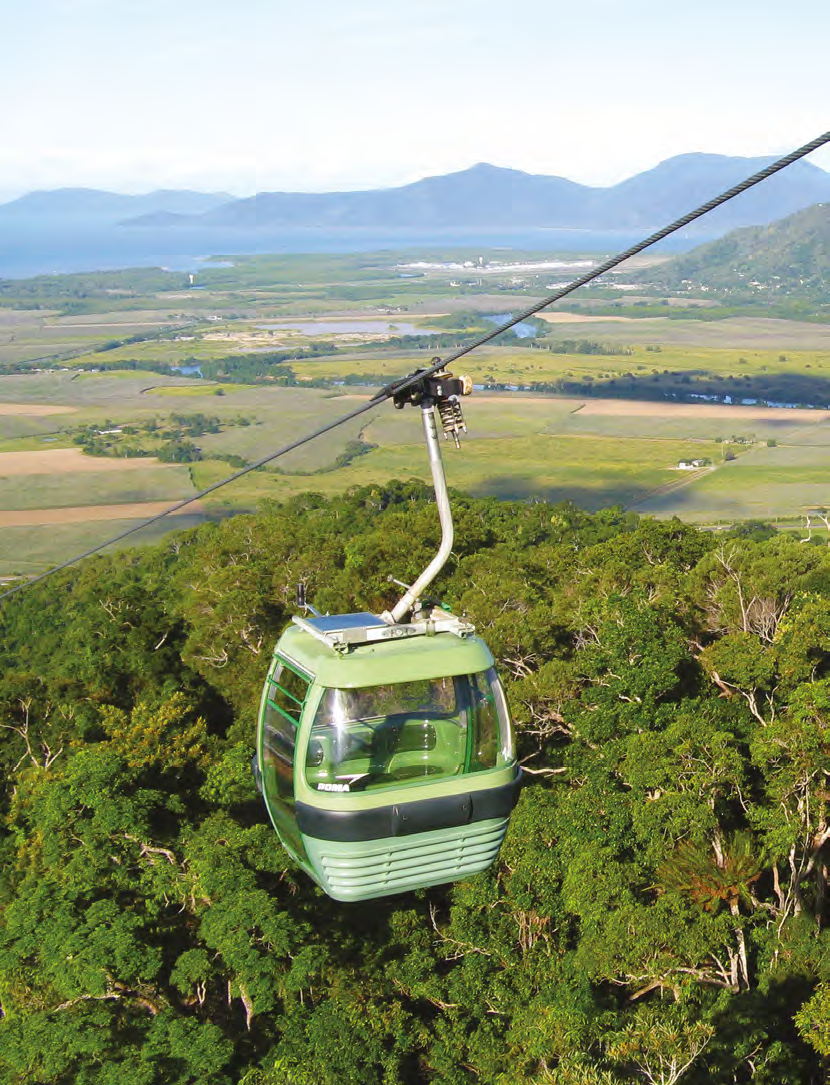
Skyrail from Kuranda
When we set off to tour FNQ in the dry season I didn’t think it would be so FN wet. It started raining early in June at Taylor’s Beach (east of Ingham) and continued raining as we travelled up the Cassowary Coast through Tully and Innisfail. It was still raining nine days later when we arrived on the Atherton Tableland. The region around Innisfail lays claim to Australia’s highest annual rainfall and Tully claims the title as Australia’s wettest town. The town has erected a Big Gumboot to commemorate 1950 when 7.9 metres of rain fell on the town, claimed to be an Australian record. So far as we could tell, the day we visited Tully, it was trying hard to set a new rainfall record. I’m seriously thinking of hiring us out as drought breakers after we have had so much rain. The same thing happened last year when we toured Tasmania for two months and rain dogged us throughout that trip.
The edge of the Atherton Tableland is riddled with waterfalls and we visited all of them. The prolonged rain ensured that the normally delicate veils of water were fl ooding. By the time we arrived in Cairns there had been so much rain in the wet tropics, it was seriously jeopardising our plan to drive to the tip of Cape York. If it hadn’t stopped we would have had to reconsider our plans.
We had only ever heard about Mission Beach and it sounded like a good place to stay for a few days, despite the rain. It’s another one of those magnets for backpackers along the Queensland coast. And there’s a good reason why they go there; the beach is one of those archetypal stretches of tropical sand lined with palm trees. Even though it is still showing signs of the devastation caused by cyclone Yasi in 2011, it hasn’t lost its appeal.

Pavillion at Paronella Park
Our next destination was Paronella Park on the Canecutter Way between Silkwood and Innisfail, about an hour-and-ahalf drive south of Cairns. The first time I saw it was in one of those Qantas ads with the children’s choir. I remember thinking “Why are they featuring those Mayan ruins in some South American jungle in an ad promoting Australian tourism?” Anyone who has been there will know the story of the Spanish immigrant who built his dream in 1933. There is nothing but ruins left of José Paronella’s castle and most of the other buildings, but it is still remarkable to see what he built, almost single handed. The setting next to the Mena Falls is simply stunning and the paths and gardens around the park are enchanting. If you go there, do the night tour. The mood lighting creates a totally different ambience; just make sure you wear lots of insect repellent.
After Paronella we headed further inland to try to avoid the rain. Just north of Atherton, on the Kennedy Highway, we were looking for somewhere to camp for the night and stumbled across the Rocky Creek Memorial Park which is a vast free camping area. In the morning I went for a wander and learned that it was the site of the field hospital servicing the Australian WWII training grounds in the area. My dad did his jungle training here in 1942/43 before being sent to New Guinea to defend Australia. It was a very emotional moment for me when I found a plaque commemorating his unit. Here’s a bit of trivia: when dad landed in New Guinea it was the first beach landing by Australian troops since Gallipoli.
We continued to dawdle north towards Cairns in continuing rain. Fortunately, our arrival in Cairns coincided with the rain stopping, at last. On our first afternoon we visited the Cairns
Tropical Zoo at Palm Cove, north of Cairns. We got there in time for the crocodile show. It’s always fascinating to see these monsters close up. After that we went to see the free flight bird show. This was the most amazing wild animal show I’ve ever seen. No wires, no nets and half a dozen wild birds put on an awesome show; flying free, performing on command, while the trainer told us interesting facts about each of them. The zoo has other exhibits including snakes, marsupials and birds and is well worth a visit.

Kuranda Scenic Rail
We finally arrived in Cairns. It’s one of the closest parts of the mainland to the Great Barrier Reef. Any visit to the region should include a trip to the reef. We had a very early start to get to the departure wharf by 8.15am to catch the Reef Rocket to Green Island. The cruise takes about 45 minutes. Captain Cook named Green Island after the astronomer on board the Endeavour. When you approach the island it looks like there is nothing there, but the tropical rainforest bordering the beach hides a well-developed resort and tourist precinct. We began our Green Island experience by walking along the beach which rings the island. That took about 50 minutes because it’s only a small island. There are some really nice spots on the beach but it helps to get out of the wind on the lee side. Then Slava went off to view the reef and fish in the glass-bottomed boat and I went to do some snorkelling next to the wharf. The reef around the island isn’t spectacular but there are lots of fish and enough coral to make it interesting. Then we caught the Reef Rocket again and were back in Cairns by 1pm.
A day later we had another early start to drive to the Skyrail terminal by 9.10am – well, that’s early for us, and anyway it was Sunday – before transferring by bus to Freshwater to catch the Scenic Railway to Kuranda. The trip up the Barron Gorge had its moments, such as when we crossed the two long bridges where the train swings back on itself and gave us uninterrupted views back to the coast. The train slowed at the appropriate places to allow passengers to get pictures along the way. We had a 10-minute stop at Barron Falls and could disembark, but the view of the falls is partly obscured by trees. After that it’s only a few more minutes on the train to our destination at Kuranda.
Rather than going straight to the markets that made Kuranda famous, we did the Jungle and Jum Rum Creek walks through the rainforest. It’s an alternative way to the Heritage Markets anyway. We had some German sausages for lunch and had a look through the Emu Ridge Fossil and Gemstone Museum. It has a life-size replica Allosaurus skeleton at the entrance (sort of like a Tyrannosaurus, only smaller). For just a nominal donation it is a great museum with some fantastic fossils and high-quality mineral and gemstone exhibits. Then we went to Birdworld.
Initially I baulked at the entry price, even with a 10 percent discount voucher, but I relented and I’m glad I did. The birds all fly free in a netted enclosure and are so used to people that they can be hand fed and will sit on you, except that ornery cassowary that has its own patch where it can’t intimidate the tourists. After that it was time to walk back through town to our rendezvous with the Skyrail that would take us back down the gorge to the Vanbo. Anyway, everything in Kuranda starts to shut at 3pm after the last train has left for Cairns and the majority of visitors have gone.

Green Island, off the coast of Cairns
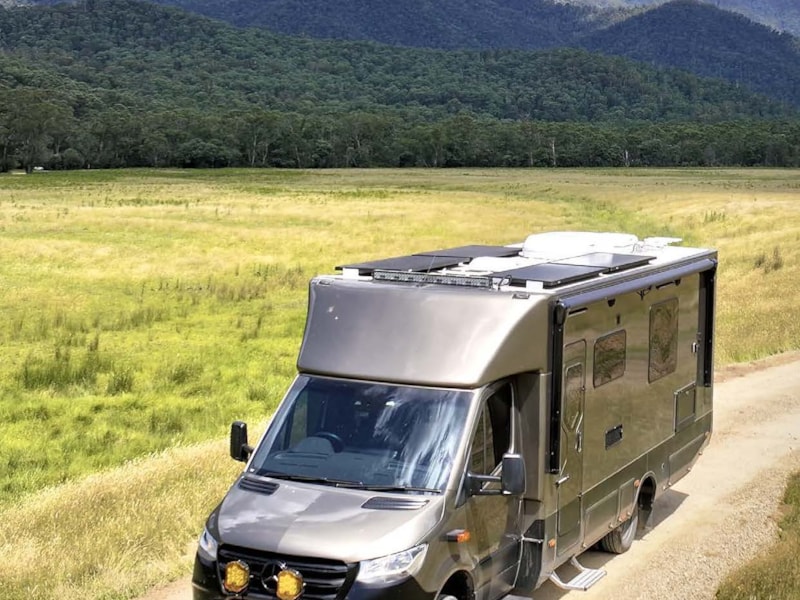
The Skyrail has two disembarkation stations. Starting from the Kuranda end, the first is at Barron Falls on the opposite side of the gorge from the Scenic Rail stop on the way up. The second is at the Red Peak Boardwalk and is compulsory; the walk to view the rainforest is not, but we did it anyway. It’s a self guided interpretive walk which explains, with living examples, the many ways that rainforest plants have adapted so they can receive the sunlight they need to grow. The final stop was back on the coast at the Skyrail Terminal at Smithfield, where we picked up the Vanbo and drove up to Palm Cove where we were staying.
At the time of writing we have been on the road for more than 11 weeks and have clocked up more than 7600km. Thanks to all those who have emailed us with comments and suggestions and hi to those who have recognised the Vanbo and introduced themselves to us along the way. You can contact us at robandslava@ gmail.com and keep an eye out for the Vanborghini.

Glass-bottomed boat at Green Island
KURANDA SCENIC RAIL
Construction of the railway from Cairns to Kuranda was a remarkable feat for the time. In 1873, there was a gold rush in the mountains behind Cairns. Supply routes to the coast were slow and unreliable. In 1882, a devastating wet season was the last straw when thousands of people came close to starvation. It was decided to build a railway connecting Kuranda to the coast. Soon after, a route through the Baron Valley was selected and after a couple of failed attempts, construction finally commenced in 1887. The 37km narrow gauge (3’6”) line from Cairns to Kuranda was opened in June 1891. That’s a heck of lot quicker than it took to build the Eastern Suburbs railway in Sydney nearly a century later.
HISTORY OF PARONELLA PARK
José Paronella arrived in Innisfail from Spain in 1913. After initially working as a cane cutter, he created staggering wealth for the time by buying land and increasing its value after clearing it and planting sugar cane before selling it. In 1929, he purchased 13 acres of land next to Mena Creek Falls. After building a home for his wife and children he began fulfi lling his lifelong dream of building a castle inspired by his childhood memories of Catalonian castles. He developed Paronella Park with picnic areas, tennis courts, tunnels and bridges and planted more than 7000 tropical plants and trees as well as installing Queensland’s fi rst hydro-electric plant (this still operates today after some renovations). Paronella Park opened to the public in 1935 and for the next 12 years was the regional centre of entertainment showing movies and hosting weddings and lavish parties. The park was almost destroyed by flood in 1946 and went into decline after José died in 1948. The park stayed in family hands until it was sold in 1977 and in 1979 the castle suffered major fire damage. In 1986, the park was ravaged again, this time by cyclone. Then, in 1993, Mark and Judy Evans saw the potential in the park, bought it and set about reviving what was left of it. Their task was set back in 2006 when Cyclone Larry swept through but the park was reopened after just six weeks. In 2011 Cyclone Yasi closed the park for repairs for another two weeks. The most recent threat to the park comes from concrete cancer but it continues to amaze everyone who visits.