The search for environmentally safe loos goes back a long way.
The search for environmentally safe loos goes back a long way. John the Fearless (King of France from 1409-1413) had a padded seat, heating, and an air circulation system to minimise the royal odour. Located at the peak of his castle it had a 25-metre drop to a septic pit that allowed the solids to settle, and drained the liquid content into the moat.
The good king’s motives were good: that urine is sterile was supported by Pliny the Elder some 950 years previously and Henry the VIII’s surgeon recommended it for sterilising battle wounds. The virtual founder of formal chemistry (Robert Boyle) advised some patients to drink their own.
This view is changing. In 2014, an American Society for Microbiology conference report noted that the traditional (Kass) test was flawed and that (for women at least) 70 percent had bacterial material.
The major problem is, however, that while bacteria are beneficial in one’s intestines during digestion and peristalsis it’s a different matter altogether once excreted. In essence any lying around a campsite becomes food (and substrate) for species that are pathogenic to humans.
This is a major issue for owners of both self-contained RVs and those who free camp regardless. It is hard to control in non-monitored campsites – and can lead to contamination and possible infection – particularly if nothing is done to clean/prevent it. It is also a problem for caravan parks and shire dumping facilities – particularly those with septic systems.
For many RV owners the main concern is controlling odours. Many products primarily address this problem but contain products that are not only non-biodegradable but kill the wanted bacteria in ‘long drop’ and septic systems. Some products are also toxic.
In this respect Australia is 35 years behind California. There, the 1979 Prohibited Chemical Toilet Additives law banned the manufacture, sale or use of non-biodegradable chemicals in chemical toilets or (any) waste disposal facility.
Two Approaches
Bio-stimulant products are environmentally friendly. In effect they accelerate nature’s aerobic breakdown of faecal matter by introducing oxidising agents (or enzymes). The aerobic process also reduces smell.
The major advantage of such products is that they can be safely disposed of in septic, environmental or the normal city-type sewage treatment plants.
The so-called biocidic approach kills all bacteria (but both good and bad). Any liquid so treated is allergenic and (some claim) possibly carcinogenic. And, without meaning to be facetious, they require a heavy chemical to reduce the stench of hydrogen sulphide generated when excreta is broken down non-aerobically.
The major issue of the biocidic approach is that the treated sewage can only be disposed of in a city-type sewage treatment plant.
It is liquid death for any septic or environmental disposal system as it kills bacteria indiscriminately and this is why some rural caravan parks are increasingly and rightly concerned about their dumping facilities.
What is (in my opinion) essential is to use only the oxygen-loving bio-stimulant (also known as probiotic) approach -probiotics are live bacteria and yeasts.
The best known products include the US Bio-Pack, and locally-made Odour- B-Gone. Thetford’s AquaKen Green and Aqua Ken Rinse (but not necessarily other related products), and also Bio- Magic. Other products claimed to be bio-stimulant are Enviro-Chem, Reliance bio-blue, Century Blue Clean N Fresh, and Chempace bioFORCE.
Those not to use
By far the number villain (ecology-wise) is anything that contains formaldehyde. To quote the US Department of Toxic Substances Control: ‘Chemical toilet additives include chemicals that are known to cause septic tank failures by killing the bacteria essential to the treatment process in the septic tank. Formaldehyde can cause these to die in holding tanks as it controls odor (sic) by killing bacteria. When a septic system fails, sewage waste does not break down and can cause an increased risk to people in contact with raw sewage.’
The same department also advises against de-odourisers such as Bronopol, Dowicil and Glutaraldehyde as they are either bacterial pesticides or retard bacterial growth.
It is advisable to check the declared content of any product. One (well known in Australia) is promoted as ‘environmentally safe’ yet the obligatory Material Safety Data Sheet states it contains Bronopol. Chemtech’s Portasol is also claimed as environmentally friendly yet its data sheet states it contains 10 g/L of Glutaraldehyde.
Also suspect environmentally are many home-made chemicals. Most contain bleach or Pine-O-Clean that, while cheap and effective, kill the needed bacteria. Fine, as may well be Napisan, if the waste is only disposed of in town sewage disposal systems – but never in environmental or septic systems.
Napisan
Many long-term caravanners swear by Napisan (or similar) rather than the more costly products. Napisan and ‘look-alike products’ contain sodium percarbonate (that breaks down in water to soda ash and hydrogen peroxide). An additive is included to make the result smell ‘less bad’.
While effective from an RV user viewpoint, a major issue is that ingredient information is hard to obtain for the look-alikes. One nappy soaker product for example contains non biodegradable chemicals that are potentially toxic to marine life.
The main concern is that while many such products are promoted as biodegradable to Australian Standard 4351 – that Standard only relates to socalled ‘surfactants’ – that allow or promote wetting (i.e. the detergent effect).
This topic arises frequently on forums and results in often heated exchanges. The problem, however, is that most participants relate to their effi cacy in breaking down waste matter and smell reduction – at which they are very good. But the jury is very much out on their environmental effect.
Alternative Approaches
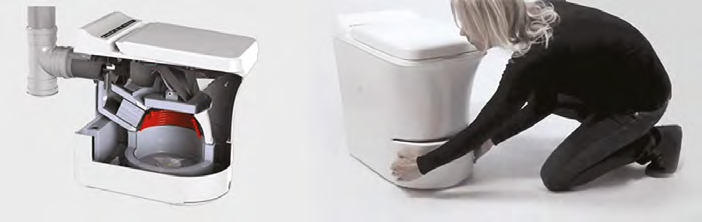
One, a model of which has the apposite name of the Cinderella Motion, has a small incinerator under the toilet seat. Combustion gases are expelled through a separate ventilation pipe. The RV version is powered by LP gas plus 12 volts for the ventilation fan and control panel, but no water or drain connections are required – nor are you exposed to the waste. It looks like any other toilet but has a small bag (a new one must be used each time) to catch the waste. You do your thing, close the lid, hit the start button – and that’s it. The maker claims the toilet can be used around 100 times before emptying. Depending on the type of ‘deposit’ combustion takes about 30 minutes.
Another interesting approach exploits that the human body directs the waste products in two directions – the maker (Natures Head) produces a waterless toilet that separated liquids from solids and composts the solid waste by adding peat moss. (A shame that King John did not foresee that one).
Leave No Trace
The above may hopefully assist the CMCA’s Leave No Trace (LNT) program, which enables those travelling in a self-contained RV to be able to use locations lacking toilet facilities without ‘having a negative impact on the environment.’ The main requirement to qualify is that the RV must be able to retain all waste products, and agree to leave no trace whatever of having been there.
It may assist were some guidance to be provided into only using biofriendly chemicals that are acceptable for environmental and septic system. These are always fine for waste water treatment plants – but there is a major risk of biocidic chemicals rendering a costly septic system permanently unusable.
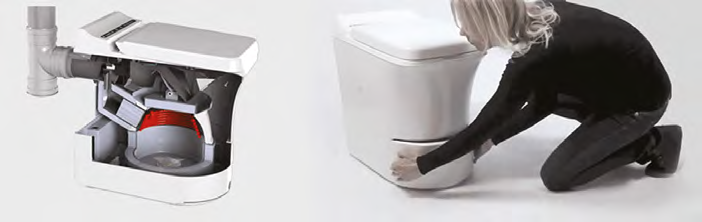
The Cindarella Motion incinerator unit