Fifth-wheel trailers have a somewhat unexpected history!
The concept of pivoting front axle farm carts goes back to the 1300s. By the 1700s similar pivoting axles were commonplace on carriages. They worked to a point but, because the steered wheels needed to be of small diameter to allow turning clearance, the ride was very hard.
In the mid-1700s Charles Darwin’s grandfather (Erasmus Darwin, a travelling doctor) further realised that, while turning sharply, the pivoting axle causes the four-wheeled chassis to in effect become an unstable triangle. To overcome this Erasmus went on to invent the Ackerman steering system used to this day in cars and trucks. He also invented a canal barge lift, a copying machine and a rocket engine. He also wrote poetry and (in 1794) completed Zoonomia – or the Laws of Organic Life – that his grandson later revised.
What is believed to have been the very first motor-drawn fifth wheeler (a car carrier) was developed, in 1898, by the Winton Carriage Company (Cleveland, Ohio). It was based on a car chassis with a rear engine. The fifth wheel coupling was located above the engine.
In 1914, Detroit blacksmith Augustus Charles Fruehauf built a fifth-wheel trailer (attached to a Model T Ford) as a boat hauler. He coined the name ‘semitrailer’ and went on to build the now giant Fruehauf Trailer Company. A similar (also Ford pulled) ‘Trailmobile’ was produced by John Endebrock in 1918.
FIFTH-WHEEL COUPLINGS
The couplings used back then were basic. They were usually a hand-forged metal (part) circle located over the rear axle of the truck. A second plate attached to the trailer rested on the truck section, located by a heavy pin. This worked well enough but the trailer had to be raised and lowered to enable the pin to be pulled in and out to uncouple the rig.
There were many variations of this but what was really needed was a coupling that enabled coupling and decoupling without lifting the trailer.
This development of this was legally murky, but is generally acknowledged to have been the Martin Rocking Fifth Wheel in 1916.
John Endebrock’s 1919 hitch mechanism was very similar to present-day couplings but was eclipsed by the Fruehauf’s 1926 developed unit that enabled coupling and uncoupling to be done automatically by moving the tow vehicle.
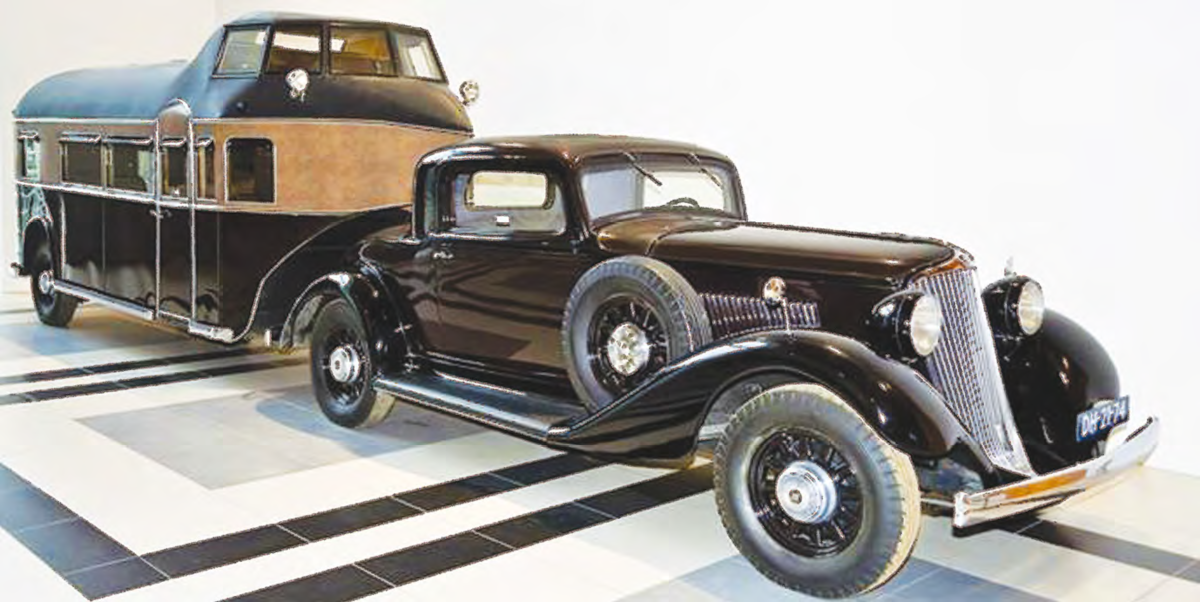
The first known fifth-wheel caravan was made in 1917. It was believed to have been designed by the legendary engineer Glenn Curtis. His superbly made and costly units were in common use (in the USA) from the mid 1920 onward. Some had passenger accommodation.
Today’s fifth-wheel caravans use hitches that are either a smaller version of the above, or a so-called goose-neck coupling generally similar to a conventional caravan tow ball.
WHY THE FIFTH WHEELER?
All conventional trailers have the physically inherent flaw of being towed via a hitch that is 1.2-2.0 metres behind the rear axle of the tow vehicle. This causes two problems. Firstly, the (essential) nose weight of the trailer levers up the front of the tow vehicle – reducing the grip of the steered wheels. Secondly, if the caravan or tow vehicle sways (yaws) that overhung hitch causes (not just allows) the other to sway in the opposite direction. It is significant that many large companies were formed to develop products that partially address caravan stability problems better fixed by removing the cause for their need.
The major dynamic benefit of the fifth-wheel concept is that (if followed correctly) it eliminates the front end lifting effect (and so-called) mechanical phase reversal that results in snaking. If used to towing a conventional caravan, towing a fifth wheeler is a revelation.
As long as the tow hitch is directly above or in front of the tow vehicle’s rear axle, it has no lifting effect, nor is sway actually generated. If, however, the hitch is substantially behind that axle that trailer is no longer (dynamically) a fifth wheeler. It is an unstable conventional caravan with huge nose weight that also undermines the steering of the tow vehicle.
USABILITY
To an engineer, the major (huge) benefit of the fifth-wheeler caravan is its inherent stability. If a caravan longer than 5-6 metres is required (to my mind) that alone is adequate reason to buy one.
For most buyers, however, the major benefit is that the whole unit’s area is usable enclosed space. A typical (say) eight-metre fifth wheeler and tow vehicle is (on-road) about the same length as a six-metre conventional caravan and tow vehicle. While 8-9 metre caravans are made most require a big Ford 350 or Dodge Ram to tow them – but many are hauled by 4WDs of two-thirds the weight.
The further benefit is (that as with a conventional caravan) the living space is separate from the locomotion. This is particularly handy if the tow vehicle needs servicing – or one needs to drive into town to go shopping.
Price, too, is a consideration. Locally made product is usually more costly, but like is not necessarily being compared with like. Some US-made fifth wheelers only seem bargains. Many of the larger ones are intended as travel trailer park homes and carried there by trucks. They are mobile but not built for routine towing. It is also widely claimed they are hard to sell second-hand.
Unless you are seeking a large fifth wheeler as a rarely-moved home, my strong advice is to buy only locally made (or locally designed USA-made) product.
A further issue is that many imports are so heavy that, to keep the nose weight to that which the tow vehicle can handle, the vans’ axles are close to centrally located. This introduces an unpleasant 'nodding’ and fore/aft shunting effect. This can be partially tamed by using an air-suspended hitch, but the van will never be as stable as one with reallocated axles.
One of the few fifth wheeler downsides is that they are not suitable for towing on narrow off-road tracks. This is because the rear wheels tend to run wide when turning. This can make cornering difficult on hilly, winding tracks, particularly where there is a drop off to one side.
The development and pros and cons of conventional and fifth-wheel caravans are covered in depth in Collyn’s Caravan & Motorhome Book.