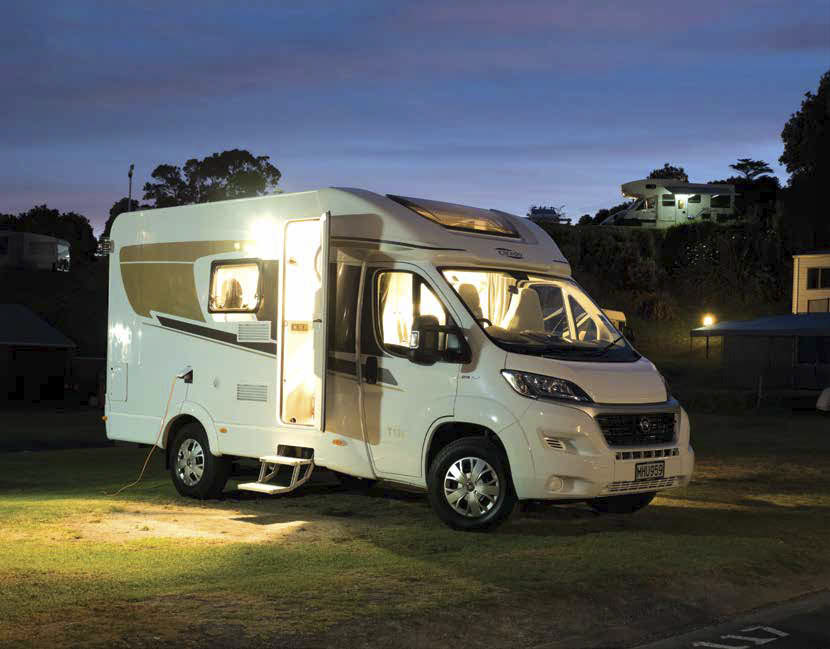
What kind of battery does your RV run on?
Judging from comments in various social media forums, the question of the replacement of house batteries is a subject of regular discussion — particularly the topic of replacing absorbed glass mat (AGM) with better capacity lithium-ion (LiFePO4). There are undoubtedly some good reasons for upgrading, but it’s not a given in every case.
Batteries have become a major component of many a recreational vehicle (RV), particularly those set up for off-grid living and remote travel. In some ways batteries have changed much over the last decade or so, but in others, things have remained much the same. For instance, a lead acid battery is still a lead acid battery in various forms. Most DC systems are still 12V and, for connecting things up, batteries can still be wired in a series or parallel connection. If used this way in order to improve the load capacity, there are a few provisos. In particular, the batteries should be of the same type (i.e., both AGM), of the same rating, (i.e., 100AH) and of the same age. Anything else may be detrimental to either battery and may reduce battery life overall.
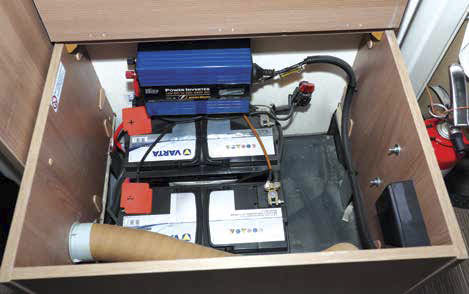
Peukert’s Law helps to determine battery life
BATTERY TYPES
As far as the RV crowd is concerned, there are generally two types of batteries. There are those used for starting engines (both tow vehicles and motorhomes) and those used for everything else. Starter batteries are designed for high current, short time operation, while deep cycle/lithium-ion batteries are used for everything else. Deep cycle batteries are available in three different forms — flooded, gel cell, and AGM. The latter is the most commonly used these days.
While it’s recommended that neither battery be used for the alternate function due to being detrimental to battery life, in an emergency anything can be tried. Some years ago, at least one motorhome manufacturer had an emergency switch installed so that the house battery could be used for starting the engine. Likewise, starter batteries can be used for an extended deep cycle function, but in order to prolong battery life they need to be recharged as quickly as possible.
ABSORBED GLASS MAT BATTERIES
AGM batteries were originally developed for the military and have an absorbed glass fibre mat that sits suspended in an electrolyte. Being designed for a rugged life, they are fully sealed, and are designed to be maintenance free and able to withstand mechanical handling or something like vibration on corrugated roads. You can see why the military liked them. Of all the deep cycle batteries, AGMs have the lowest self-discharge rate. It’s not a perfect solution, though, because AGM batteries are affected by extreme heat locations, like engine bays. The other problem with AGM batteries is that battery life can be shortened if frequently discharged below the 50% level. It’s a mistake to think that a 110Ah battery will give a 10A current for 11 hours — it won’t, because something called Peukert’s Law comes into effect. The short version is that when the rate of battery discharge increases, the available capacity of the battery decreases and it’s possible to determine battery life from said law.
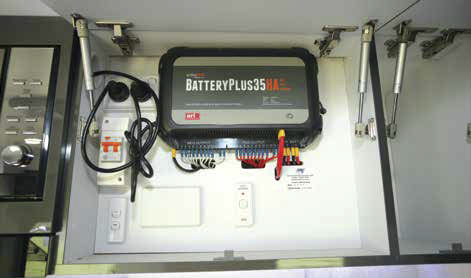
Is it time to consider a change to your battery setup?
LITHIUM-ION
LiFePO4 batteries have certainly changed the power scene in RVs. Undoubtedly the prime advantage is that lithium-ion battery output voltage remains constant, even when down to 10-20% of their charge. For a given output, they are lighter and smaller than conventional deep cycle batteries. They can also be charged and discharged at a relatively high current.
So far so good. However, there are a few other things to consider. Lithium-ion batteries have a different charging cycle to the AGM type. They should not be installed into an existing system without considering all other components, particularly the charger. Unlike other batteries which can be monitored as a single entity, each cell in a lithium battery must be monitored individually because one cell being fully charged will cease the charging current to all cells.
When batteries are charged from more than one source, i.e. a mains charger, Anderson plug, or solar panels, this becomes more complicated. In the latter case, a regulator is essential and in recent times, integrated power system units have been developed that manage all solar and battery systems, as well as having inverter output as well.
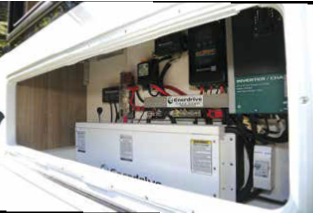
AGM setups are the most popular
WHEN TO UPGRADE?
Economics get into the question of whether or not to replace AGM batteries with lithium-ion. The latter is somewhat more expensive and there’s the possible extra cost of a charger/battery management system. It all comes down to whether the existing battery set up is coping with the 12V demand without affecting battery life. If changes are being considered like an increased 12V load, maybe replacing a three-way fridge with a 12V compressor model or a maybe a desire to get off-grid more often, then looking into a lithium-ion upgrade may well be worth it. A slightly lesser issue is whether there’s a need to shed a bit of weight or gain a bit more storage space without affecting battery capacity.
The bottom line here for many people is that if your current AGM battery setup is performing well and suited to your needs, then there’s no need to upgrade. Otherwise, it might be time to consider a change.