Understanding RV weight and overweight caravans
A growing problem on Australian roads is overweight RVs. A perusal of social media sites reveals a lack of understanding of legal weight requirements when towing a caravan. The industry solution for heavy caravans is buying a heavier-duty tow vehicle, but that is not always the best choice. So what is the solution?
Better-educated travellers is one way to improve things, and companies like Getabout Training Services (Tow-Ed) do just that. Getabout has a contract with Transport for NSW to facilitate its public education and weighing programs.
Getabout Training General Manager David Foster says, “The overweight caravan situation is at a stage where it is detrimental to the owners and other road users; however, for the majority, it is not necessarily through lack of trying to be within the limits”.
“When we come across people who have an overweight problem, most are surprised or at least understanding of the implications.
“Although caravan manufacturers play a significant role in the situation, the 'I need' factor (think coffee machine, washing machine, 400Ah of lithium batteries, solar panels and fancy bench tops) is very consumer-driven and just as big a factor.
“The data we have indicates that for dual axle combinations, we see weights over their permitted limits across GVM, GCM, and TBM; however, when we review the data for single axle trailers, there is greater non-compliance with ATM and GTM. This tends to indicate that caravans and what is now included in them are simply being built too heavily. “
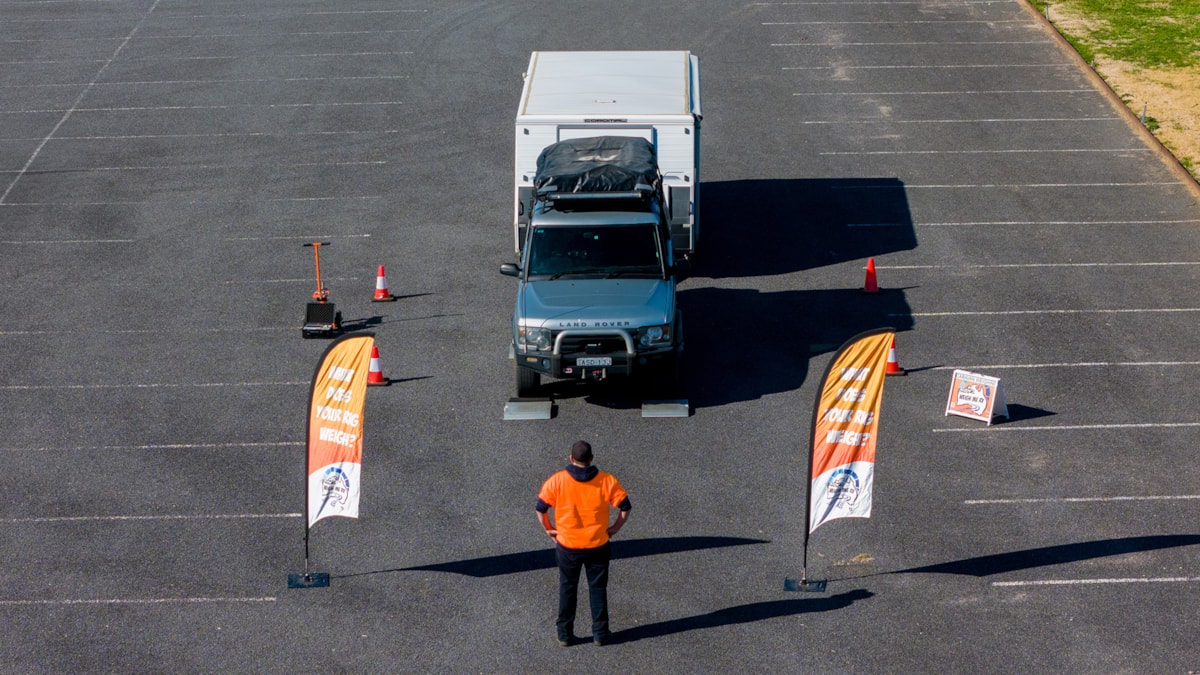
Foster recommends getting your caravan or motorhome professionally weighed, and says whilst it may reveal some unpleasant truths, it will make caravan travel for everybody much safer. There are plenty of weighing services, mobile and otherwise, to make use of.
Sometimes, in a fully loaded caravan, it is a matter of shifting the load around to keep within all the weight limits and have a stable tow. The preferred location for anything really heavy is low down and over the axles. Medium-weight items should be toward the front of the van, and lighter-weight items should be higher up. The reasoning being that anything heavy, high up, or towards the rear may cause the van to swing around excessively.

Shedding weight
If you haven’t done so for a while, then it’s not a bad idea to check out everything in your caravan or motorhome.
There may be items occupying storage space that haven't been used in a long time and could be offloaded, reducing weight.
Anyone who has travelled in a plane will know that clothing has weight, particularly winter clothing, and you may not need something for all seasons. All the mechanically minded like to have a toolbox along, but tools can be pretty heavy, and some are better left in the garage.
The confusion around Utes
What confuses many caravaners is ute manufacturers in particular, who advertise a maximum towing weight of 3500kg (to make it sound heavy-duty). However, many of those identical vehicles have a Gross Combined Mass (GCM) of 6000kg.
Let’s say your caravan has a loaded weight (the ATM) of 3500kg. The ute tow vehicle has a GCM of 6000kg. Subtracting the loaded caravan weight from the GCM gives a figure of 2500kg.
Say your ute has a Tare Mass of 2250kg; that leaves 250kg for any load, be it diesel fuel, passengers, tow bar, bull bar, toolbox, or roof racks. The Tow Ball Mass on the tow vehicle is included for the mathematics in the caravan weight.
Chances are you will have exceeded the GVM of the tow vehicle and will be well over the 6000kg GCM, with absolutely no margin of safety. Another problem that can occur is that the tow vehicle's GVM is exceeded, even if the GCM is not.