Australia’s Murray Darling basin is massive, draining almost a quarter of the country from Victorian highlands through to Queensland’s Channel Country. A series of muddy, slow-flowing channels and billabongs the rivers snake their way through semi arid land and hardly seem a likely place to wet a line. Looks, however, can be deceiving because these discoloured waters are loaded with one of Australia’s greatest little battlers – the yellowbelly.
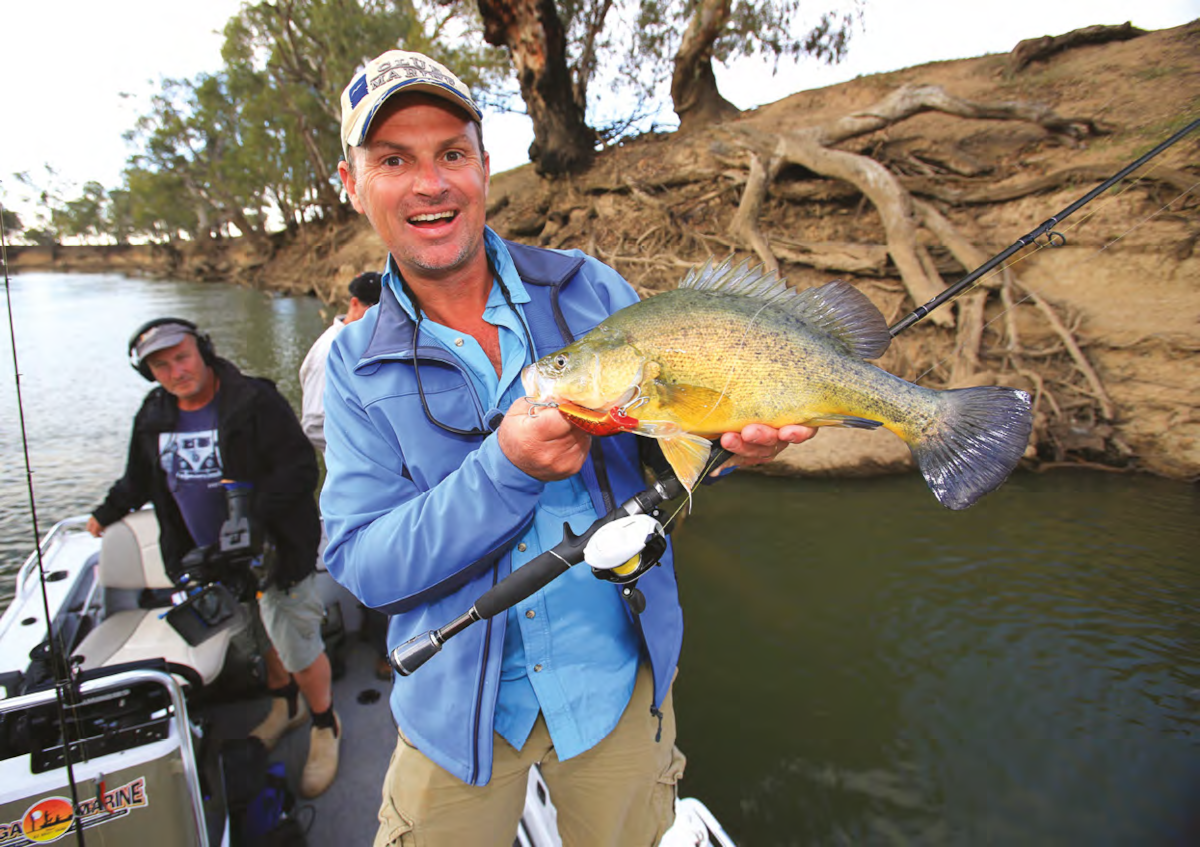
Also known as callop or golden perch, yellowbelly rarely grow to weigh more than a few kilos in the outback rivers. Alternatively, those stocked in impoundments like Windermere can grow more than five times in size. What the outback yellowbelly lack in size they more than make up for in number. After years of abuse, our river systems have been on the mend recently and the yellowbelly have also been on the increase.
However, as common or as widespread as they may be, yellowbelly tend to congregate around particular areas. Recognising these spots is often the first and most vital step to success. Good places to start are areas such as Bourke, the Menindee Lakes, Hay and Lake Mulwala. That said, with stocks increasing they are turning up everywhere.
Picking a location is one thing but you need to get more specific and pinpoint exact spots. The first places to look are the deeper sections of the rivers, commonly referred to as holes. Flow is just as important. Yellowbelly are also very structure oriented and like to hang out near cover.
Areas like drowned timber, rock bars, drop-offs and undercut banks are all prime yellowbelly habitat. This is particularly so if all the factors are present like a tree that has collapsed into the water, on a steep bank right in the path of the main current.
Yellowbelly love a bit of current as it creates highly oxygenated water. Quite often yellowbelly will school in large numbers around weirs when large volumes of water are being released. Combine structure, deep water and current and chances are you will bump into a few yellowbelly.

Like most natives, yellowbelly are very sensitive to weather variations and as a general rule they are most active when the temperature is starting to warm up. The peak fishing periods usually occur in the spring and autumn, while summer tends to heat the water too much. As for the time of day, early morning and late afternoon tend to be the best. However, a rising river or an approaching storm front can also spark the fish into action at any time of year.
Yellowbelly are relatively easy to catch. There is no need for expensive tackle, in fact many anglers fish for them with hand lines, although a light spin outfit is the easiest to use. The best rig for yellowbelly also happens to be the simplest. A wide gape (size 4 to 6) or a suicide hook (size 1/0 to 2/0 ) tied direct to the main line and a light, free-running ball sinker is all that is needed to get you into the action. This rig only involves one knot, making it almost childproof. It is also quiet versatile and can be fished effectively from either boat or bank.
Yellowbelly are opportunistic feeders and will eat everything from yabbies to small carp, however, their favourite food is undoubtedly the humble freshwater shrimp. Shrimps are abundant in all the rivers and billabongs and can be easily caught with the aid of a yabby net. Fine mesh box nets are also effective but experienced anglers will quickly tell you that yabbies and freshwater crayfish will make short work of these flimsy contraptions.

Pinned lightly through the tail the shrimps will stay alive for a long time, their frantic kicking quickly attracting the predators. With no teeth yellows can’t chew, instead they simply suck in their food in a similar fashion to barramundi. This means it can be hard to detect a bite but by the same token hooking up is relatively easy because the fish quickly swallow the bait.

For anglers willing to go a step further, lure fishing can be also be rewarding. Lures like RMG scorpions are deadly but the all-time favourites are spinnerbaits like Icon Carnage. Generally speaking, the lures work best when the water clarity is good. A slow retrieve is mandatory and it is essential to focus in tight around snags or rock bars for the best results.
When it comes to native species it seems the Murray cod hogs the limelight, due to its larger size. However, in reality, for most anglers wetting a line in outback rivers it is the humble yellowbelly that saves the day. So next time you are travelling through the outback and you cross a river or a billabong why not pull up and wet a line.