Join Sue and John as they navigate a memorable trip (for all the wrong the reasons).
Edward Murphy was a pessimist. He believed that whatever could go wrong, would. That just about describes our trip last winter. Nothing major, but so many little problems.
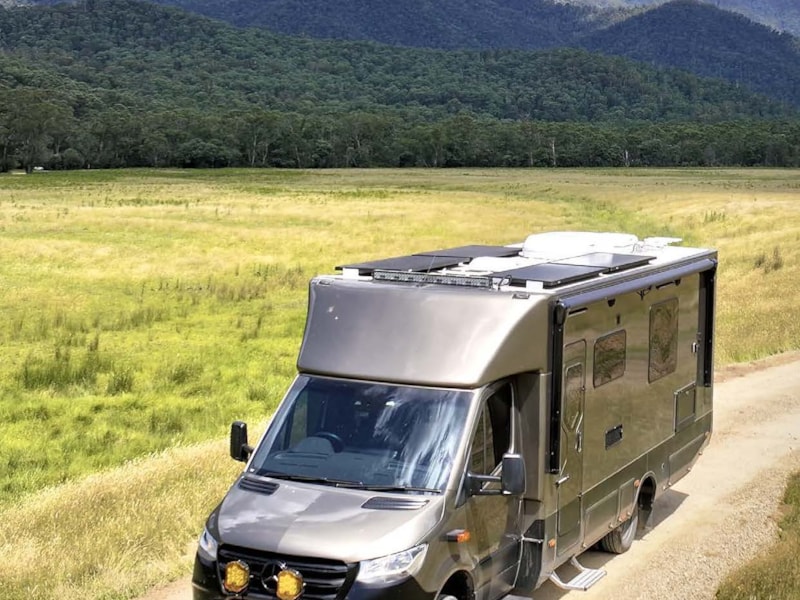
It all started in early May in the Victorian city of Geelong, where we disembarked the Spirit of Tasmania in our 2014 Fiat Jayco motorhome. Actually, it probably started before we even left home when the TV aerial lead broke. It couldn't be fixed until after we returned home.
The original plan was to head to Queensland, visiting our kids and their families in Victoria, New South Wales and southern Queensland on the way. We got to inland New South Wales when the weather bureau forecast an east-coast low with lots of rain, which turned into a major flood event. We would have landed right in the middle of it. Instead, we changed direction and headed west.
We called into Junee to see the Roundhouse Museum, then travelled towards Peterborough in South Australia. It was bitterly cold as we celebrated our 52nd wedding anniversary.
Further west, we travelled to Ceduna via Port Augusta, enjoying an overnight stop at one of our favourite places, Tcharkuldu Rock. An eerie fog enveloped the rock, lingering as we continued on to walk around nearby Pildappa Rock, the longest ‘wave’ formation on the Eyre Peninsula. Both granite outcrops were used as water catchments in the early days of European settlement.
It was the second time we had crossed the Nullarbor, so we knew the drill – food, fuel and water before venturing out. It’s about 1,200 kilometres from Ceduna in the east to Norseman in the west, and we intended to take our time and really savour the journey.

RUNNING ON EMPTY
At Ceduna we met a solo-woman traveller, reminding her of the importance of a water refill before setting off. It was a few days since our last water refill, so we knew we had about half a tank left. The first place we tried for water had an “out of order – go to the caravan park” sign, so we did. We paid $5 for a refill, then set up our hose and filter. Occasionally we have an airlock problem in the breather hole. This time, whatever we tried, no water would go into the tank. We decided to get out of town, camp for the night and work out a solution. But the out-of-town camp didn't eventuate. We instead continued on to the Nullarbor, not an ideal start to crossing the desert – with no water available until the other end.
The second day on the Nullarbor started okay but deteriorated with a strong headwind blowing by early afternoon. Behind us that strong wind developed into a dust storm. Thankfully we missed that, together with a tornado up ahead the following day. Murphy didn't have it all his own way.
Reaching Norseman after three days, our first stop was the visitor centre to purchase a water token. But our camper refused to cooperate, and our token was out of time. Luckily, help was at hand. Many thanks to the local council worker who came to our aid, using an air compressor to blow down the breather hole. But by this point, the visitor centre was closed. No more water tokens – no water. We didn't know at that stage that the local service station had water available for a donation. Thankfully we were able to fill up the next day on the way to Esperance.
At Esperance, we stocked up the fridge and headed east to Lucky Bay in Cape Le Grand National Park. Well, not quite. You need to book online before you go. There's virtually no signal at Lucky Bay, and I got the date wrong. We had a night to spare before our booking. We ended up travelling further east to the most expensive overnight stay of our trip at Duke of Orleans Bay.
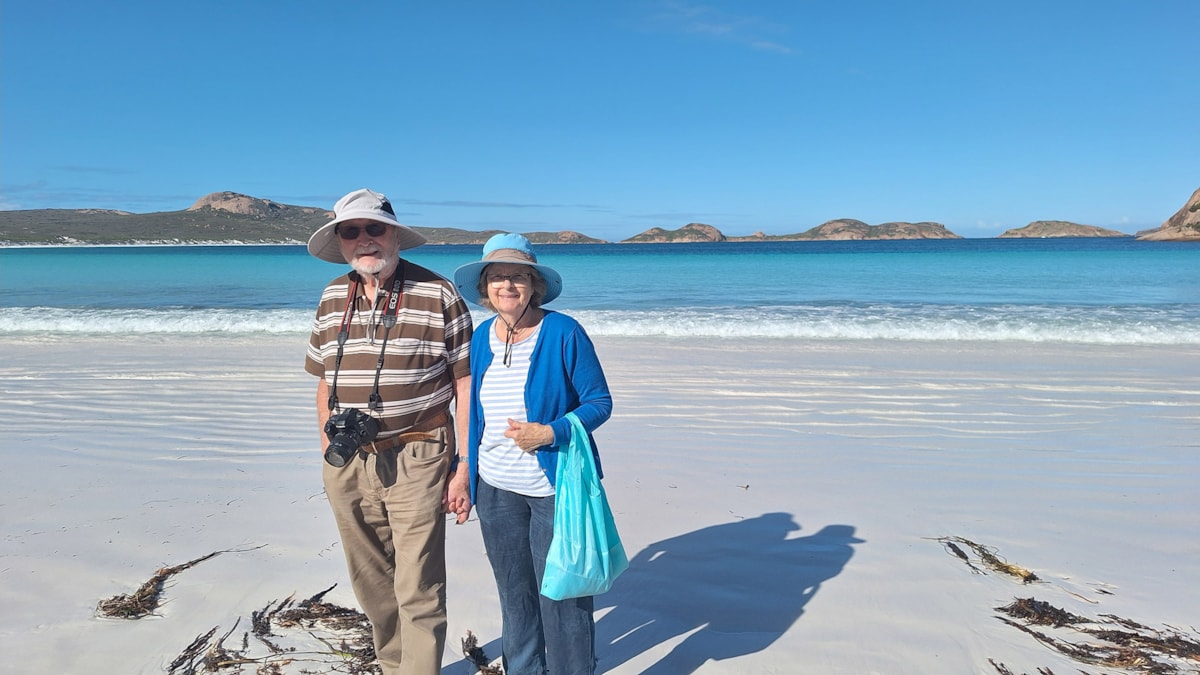
Lucky Bay has to be our all-time favourite place – a beautiful camping area overlooking the bay and a beach to die for. It was ‘discovered’ and named by explorer Matthew Flinders on a stormy night back in 1802 during his circumnavigation of Australia. There is a cairn in his honour on the headland at the end of the beach. The sand was so fine – squeaky white – with beautiful aqua-marine coloured water, kangaroos on the beach and wildflowers on the walking tracks between bays. It was absolutely unforgettable; a place to relax, walk the beautiful beaches and see the local wildlife.

It was a Sunday when we arrived back in Esperance. Unknown to us, everything is closed on Sundays. The cheapest unpowered site on offer was way out of our price range. We moved on. The next large town to the west was Albany, about 500 kilometres away. On the way, we stayed a couple of nights at the little seaside village of Hopetoun, planning to do a supermarket shop at Ravensthorpe. But the town’s only supermarket closed six months before we got there.
We found a golf club in the Albany area offering overnight stays. From there, we spent several days touring the area, mainly dodging rain showers and gale-force winds, before moving on to one of my favourite places – Cape Leeuwin Lighthouse, where the waters of the Indian and Southern oceans meet.
Meanwhile, John found what we hoped would be a permanent solution to the airlock problem in the water tank. A length of narrow flexible hose, poked down into the breather hole. A sharp blow and stand back. So far, it hasn't failed. We hadn't finished with the camper gremlins though. One evening, I went to open the bathroom cabinet and it was jammed shut. Unable to be opened.
TOURING THE SOUTH-WEST
The cave systems in south-west Western Australia are magnificent and distinctly different from each other. We toured the beautiful Jewel Cave then ventured on to nearby Hamelin Bay, famous for its sting rays. But it was so windy and the sea so rough, the rays were well hidden beneath the waves. On to Busselton, and the famous jetty was closed in high winds (the following day it was dead calm). We walked the length of the 1.8-kilometre jetty and later found a great Member Stop Over Facility in the area. Many thanks to Mary-Anne for such a warm welcome.
North of Perth, we enjoyed a day at The Pinnacles in Nambung National Park and the nearby stromatolites, ancient life forms in a salty shallow lake. We stayed at the beautifully secluded Tuarts Reserve free camp in the driving rain, as wild bees buzzed around their hive in a nearby tree.

We opted for a different touring route back, taking the inland highway south. But it rained and the highway was full of trucks. Passing by in the opposite direction was the Shitbox Rally, an eclectic bunch of vehicles raising money for the Cancer Council. We passed through the hilly outskirts of Perth and headed west to Coolgardie and Kalgoorlie, climbing Bruce Rock, Totadgin Rock and Merredin Peak on the way. These huge granite rocks are scattered all over the wheatbelt and beyond. Eventually we headed south back to Norseman to prepare for our return Nullarbor crossing.
CAMPER CONUNDRUMS
One day, while stowing something under our bed, I heard a loud bang. The mounting frame on the new gas struts on the bed had snapped. It was a two-person job to get anything out from under the bed for the rest of the trip but that wasn't the end of the problems. A smoke alarm went off in the middle of the night for no reason, the fan on the toilet SOG unit worked loose, and the blind on the side door refused to open properly. It was either permanently up or down.
In Norseman, we refilled with diesel and water and set off east. This time we took our time, really savouring the journey. We stopped at places like Newman Rock in the Fraser Range and the old telegraph station at Eucla, where we walked through to the beach and the old jetty where supplies came in for the station. We stopped at the cliff edge overlooking the Southern Ocean, and at the Head of Bight Visitors Centre and whale watching site, before passing through the quarantine checkpoint back into South Australia.
The rest areas on the Nullarbor provided memorable camping spots, with most well off the highway. We topped up with fuel a couple of times, whatever the price was. There wasn't a lot of choice. Some nights we camped alone, other times in the company of other travellers.

Continuing east through South Australia, we paid a visit to Murphy's namesake – Murphy's Haystacks, a heap of giant boulders in a farmer's paddock thought to resemble haystacks from a distance. Someone had a good imagination.
Travelling on into New South Wales, we came across a much more arid landscape than anything we had previously encountered. From Peterborough to Broken Hill, the land was bare; red dirt, with wild goats, kangaroos and emus galore, a place definitely vying for the roadkill capital of Australia.
It was our first visit to Broken Hill, a mining town that also boasts more than 40 art galleries, including the famous Pro Hart Gallery. About 20 kilometres out of Broken Hill is the near-ghost town of Silverton, where we toured the town, old jail, Mad Max 2 Museum and more art galleries, before stopping for lunch overlooking the Mundi Mundi plains.
THE HEAVENS OPEN
With rain closing in once more, even the equestrian centre where we camped became slushy. The dirt roads around the Menindee Lakes, south-east of Broken Hill, quickly became a quagmire, with all roads closed except the sealed ones and some scary escape stories.
We camped beside the Darling River at Pooncarie before travelling on to Wentworth, where the Darling and Murray rivers meet. Perry Sandhills, just out of Wentworth, would be a place easy to get lost in, with trees seemingly half buried in the drifting sand dunes.
The next day, while on a narrow one-lane bitumen road coming out of Torrumbarry Weir, something started bashing around in the camper’s bathroom. We had hit a pothole earlier. After stopping, I ventured inside to find the bathroom cabinet door had been wildly slamming against the wall. The same door that had jammed shut about three weeks earlier. John took the door off its hinges and stowed it in a safe place until he could work on it. Then we had to cope with a broken headlight globe, not an easy fix. It required the assembly to be dismantled several times in the rain before we got it right. Even then, the new light globe is miles brighter than the other headlight.
Continuing east, we stopped in many of the small towns on the way to one of our favourite places – Tumut, a thriving little town in the foothills of the Snowy Mountains. Later, we spent time with our kids and grandkids before returning to Geelong for our return voyage on the Spirit of Tasmania.

Once home, John tried a bit of CRC lubricant on the jammed bathroom cabinet catch. It opens and shuts like new now. He fixed the SOG unit on the road and is working his way through the other little problems in preparation for our next trip.
It was one of the most problem-plagued trips we have ever undertaken. Despite that, we thoroughly enjoyed every minute of it and would do it all again. Overall, the camper did great on our 12,000-kilometre journey, and John and I arrived home in better health than when we left. What more could you ask for? (Except maybe leaving Murphy at home next time.) As for the TV aerial? We didn't miss watching TV and the aerial is still waiting to be fixed!