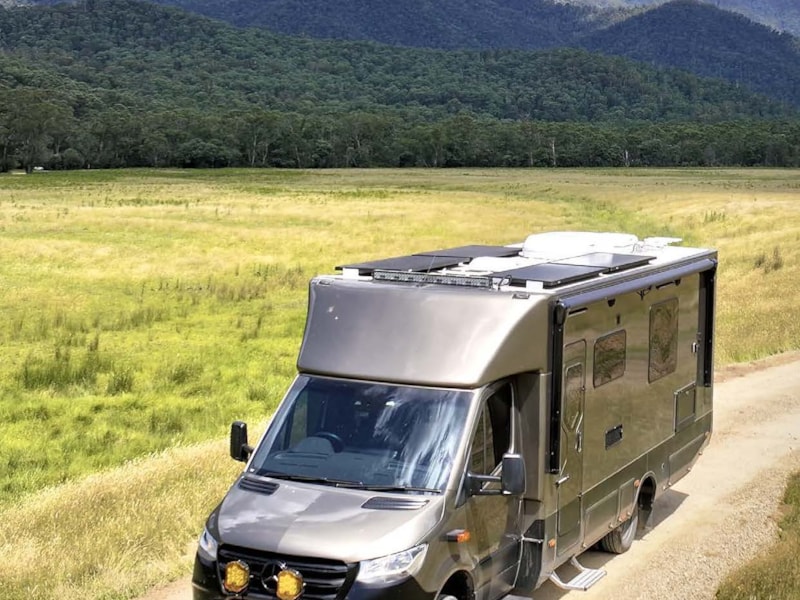
Before travelling around Australia, Adrian and Cheryl first needed an RV.
With friends and relatives singing the praises of travelling Australia, my partner Cheryl and I decided, as complete novices, to experience it for ourselves.
While most of our friends have caravans, we decided a motorhome would be the way to go for us, both as a financial consideration and a better fit for our requirements. Building our own was something we wanted to do as it would give us the opportunity to use skills developed during our working lives while hopefully saving a lot of dollars.
We decided fairly early that a Toyota Coaster would be the base for our project as it is designed for driver comfort, and although we anticipated limiting travel to a maximum 500km a day, it was important to feel reasonably fresh at journey’s end.
One of the best features of this Coaster is the ability to independently and easily adjust the front suspension and this would prove invaluable in adjusting the stance of the vehicle with the new weight distribution a motorhome conversion incurs.

It’s all about the personal touches
Probably the biggest design fault inherent in this type of bus is the lack of a passenger door. If personal mobility is or is likely to be a problem, a different arrangement of the layout should be seriously considered.
The next priority obviously became finding the right one. Eventually we found a 2010 model with low kilometres in reasonable condition. We also spent a lot of our time checking out what others had done turning a bus into a motorhome, but we felt more could be done to improve the design as a bus format places extreme limitations on finding a place for the necessities of independent travelling.
THE DESIGN
We had four main design goals. Firstly, we were determined to keep the weight as close as possible to the original unladen weight. Secondly, the layout would be an open design with 360-degree views. Thirdly, all appliances would be 240V powered and we would be gas free, and, finally, we would be completely self-contained.
Getting the vehicle to the standard we wanted took longer than expected but having a reliable vehicle was paramount so we could look forward to as much troublefree motoring as can be reasonably expected for a second-hand vehicle. The original air conditioner was scrapped because it was too much of a drain on the engine while driving and was no use when the engine was off. A 24V DC alternator was installed in its place to help charge the house batteries while driving or as an emergency top up for the batteries should a high demand situation arise. Also if we had a temporary high 240V load situation (at night or when there was little sunlight) we could keep the engine running during that period — lessening the drain on the battery system. On the roof we installed 1200W of solar panels as the main power source for the batteries (a pair of 300Ah gel batteries). A petrol powered 3500W generator with remote starting was also installed as an emergency backup for the other systems if necessary.
Facility to operate from the grid was also provided. This is used to keep the batteries fully charged when the vehicle is garaged, though a number of clear roof panels in our garage allow sunlight through to the solar panels. All of the electrics, meanwhile, are controlled by a compact and clever inverter that responds to whatever power input is selected to keep the battery pack happy.
We were able to utilise the original entry stairwell for the batteries’ location. The gel batteries work well but have a slight weight problem. Lithium batteries would have been ideal, but the price factor ruled them out. Within the replacement door frame the three entry steps were engineered to fold in when travelling.

The giant laundry-tub-cum-kitchen-sink
THE LUXURIES OF HOME
Air conditioning of the vehicle was achieved by installing a 240V domestic split system with heating capability. To date it has not had much use, as a separate cooling fan it’s proven more than adequate for ambient temperatures so far encountered. The low current draw of this domestic air conditioner should be easily handled by the batteries in an overnight situation where a more comfortable cabin temperature is required. The system is very quiet and unobtrusive.
By positioning the kitchen unit centrally we were able to provide a large flat food preparation area as well as a supersized sink, which was originally marketed as a laundry tub. It is large enough to store the microwave while travelling and handles the largest pots and frypans on board.
The fold down dining table is matched with a pair of ottomans providing us with more storage space and is conveniently located close to eating supplies and the very important ‘bar and wine cellar’. A TV has been installed on a swivel bracket over the kitchen area, with viewing from both the eating and lounge/bed areas available, as well as from under the awning. It is folded horizontally for travelling. We have a 100L freezer and a 100L refrigerator and both work exceptionally well, requiring very little power to operate. The refrigerator is essentially a bar fridge with the freezer compartment door removed which markedly improves the refrigerator performance — at the day’s end a welcome beer is at just the right temperature.
Cooking is achieved inside the vehicle with the microwave used essentially to reheat frozen dinners. An internal extractor fan was too difficult to incorporate into the design as all the roof space is taken up by solar panels. Plus, because of the relatively small interior space of the Coaster and the fact the greases and odours are difficult to extract even with a powerful extractor fan, serious inside cooking is not an enjoyable experience. Instead, an induction cooker and a toaster oven are provided for outside cooking when required. The induction cooker was a pleasant surprise. With rapid heating it produces brilliant steaks and is very easy and economical to use as well. It has been an excellent appliance that is compact, light, and easy to clean.

Twin singles/lounges with optional infill
Heating of shower water is achieved by a 240V inline heater which can be pre-set to a required temperature. Plumbing is organised to return preheated water to the holding tank while operating temperature is reached. This happens fairly quickly (less than 20 seconds) but water is so precious not a single drop should be wasted — long soaking showers are definitely out. Shower privacy is provided by shower curtains that fold away when not in use. Separate toilet and shower are located at the rear and a foldaway curtain provides changing room space when required. The toilet flushes into a 120L holding tank. The ever-present toilet odour seems to now be under control with a proprietary additive designed for the purpose — much to our relief. We have three water storage systems — green, grey and black. We have the option to utilise the grey water for toilet flushing if our main green tank runs out.
Twin single beds occupy the space over the rear wheel arches, doubling as a lounge area, and providing easy access to the bulk of our storage space. These single mattresses slide together and with appropriate infills (used as back rests for the lounge) create a king size bed.
Because we have so much glass, awnings on both sides of the vehicle are required to keep the interior cooler when camping, as obviously camping under trees for shade is not an option if the solar panels are to work as intended. Constructing our own awnings was helpful in keeping costs down.
As a footnote with regard to 240V power, a special protection device is required because a mobile vehicle cannot provide earth leakage protection. Thankfully a different system is available, and an electrical contractor/installer should be able to assist in this regard. I am not aware of any conflict of this system when the vehicle is utilising power from the grid. In our experience there have been no issues when connecting to the grid for normal operation. Problems may occur in a fault situation and anyone going down this path should seek appropriate professional advice.

Fold-down stairs provide more usable space
For our first trial run we decided to do a discovery trip with a friend, who had just bought a caravan, on a local circuit — the Burnett Region which has many scenic attractions. The circuit is roughly 1000km with a little offroad travel, so all aspects of our motorhome were tested. For both parties the trip was trouble free and with a few housekeeping modifications we feel we are ready for bigger things — as development of the motorhome will continue the more we travel, I fear I will never have this project ‘finished’.