CMCA member Bill Fikkers walks us through his latest van conversion project
The prospect of moving from a home with a high carport to a retirement village, which has restricted parking facilities, prompted me to investigate the possibility of converting a different vehicle to an all-purpose camper.
The main problem at the retirement village was lack of height, being restricted to two metres, so a vehicle less than that had to be considered. Adding to this, my Fiat Ducato was a manual and even though it was easy to drive, I now wanted an automatic.
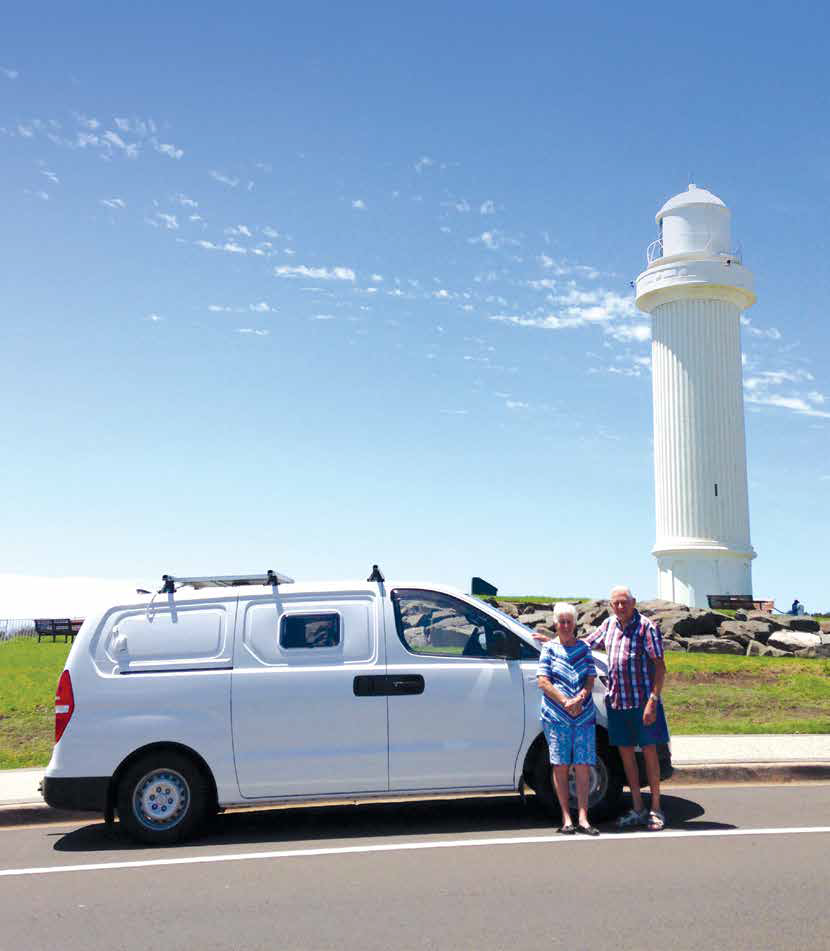
I prefer rear or all-wheel drive as they allow better traction on loose gravel roads, so the choice was limited. I settled on a Hyundai iLoad automatic with a lift up rear door. The original plan was to incorporate a lift-up roof, but this would raise the height of the vehicle beyond two metres, so that was out, and it was back to the drawing board.
The first job was to put in the wiring for both 240V and 12V. Being electrically trained, that was no problem, and I remembered that the 240V circuits had to have double pole switches by law.
Next was a timber floor and I took measurements of all the items which had to fit inside and started drawing.
As my wife is no longer able to go camping, I required only one bed.

My bed with the middle section removed
My fridge has a width of 400mm and had to fit in a position which was readily accessible from both inside and outside, so the head end of the bed area was restricted to 1200mm wide. The single bed ended up being 1900mm long by 750mm wide, with a removable middle section to allow for a table on a stand.
With the bed and fridge sorted, the cooking and sink area had to be designed for easy access, again inside or out. The result is a sink unit mounted east-west across the rear of the vehicle with a bench space for a simple Butane cooker.
The idea is to cook outside, in good weather, under the cover of the lift up back door, but to allow simple cooking from inside in bad weather.
I like having a microwave, as it makes things simple, so that was a must. Under the microwave is storage for saucepans and a gas and electric heater. Above the microwave is a small cupboard for an electric kettle, coffee, sugar and cups.
At the foot of the bed I built a storage cubicle, which contains my camping chair, folding table and a folding section for the middle part of the bed. Under the bed head, the storage space is 1200mm wide, 500mm wide and 380mm high.

Solar panel mounted on the roof carry bars
The height of the seating section was critical, as it had to allow for a chemical toilet underneath and leave sufficient head room for me to be comfortable. This area houses the deep cycle battery and charger, my sleeping bag and a box for clothing.
On top of the rear storage locker is a space for crockery and cutlery as well as towels. Also in this space is a bracket to hold the TV set. The TV set, by the way, is designed especially for RVs (sourced from Camec), as it is more robust, has a built in DVD player and USB port, so as well as being to watch TV or a DVD, I can listen to music.
For the lining of the ceiling I used three-ply with a plastic coating in a light grey colour. To fit this I made up blocks of wood and glued them onto the ceiling to create a level surface. The ply was then glued to these blocks in three sections.
There are two sliding doors at the back section, and they had to be fitted with windows. The windows are between 24–34mm thick, and of course straight, so the surface had to be built out to 24mm and allow for the curvature of the door. I did this with ply and foam insulation. The windows are double glazed EuroVision built, incorporating an insect screen and night shade. Three open positions allow the use of the windows even in rainy weather.

In camp at Jindabyne
The electrical board is mounted on the driver’s side wall above the foot of the bed. There is an automatic circuit breaker for the 240V, as well as a fuse panel and switches for the 12V circuits. A solar charge controller keeps the battery charged at the correct level and there is a 240V and 12V outlet on each side wall. Light is provided by LED lights above the table, plus one for reading in bed and one above the cooking area.
The fridge is a compressor unit which works both on 12V and 240V. During driving, the 12V is sourced from an outlet on the car console. In camp it runs on the deep cycle house battery or 240V if available.
The TV was not forgotten with a cable outlet near the fuse panel. The antenna folds up and when in use, is mounted on the roof on a short pole with a magnetic base — all very compact.
On the roof carry bars I mounted a 110W solar panel with a controller inside the vehicle, connected via Anderson plugs. Doing it this way, I did not have to drill into the roof itself.
Extra safety devices in the vehicle are a fire extinguisher and a smoke detector, the latter being legally required since 2011.
Not having a pop-up roof naturally restricts movement inside the vehicle, but it does mean that the structural integrity of the vehicle is not compromised. In good weather, most of the activities will take place under the tarpaulin off the passenger side but sleeping securely and in comfort is assured.

Sink and storage area once completed
The driving compartment has a passenger seat which, at a pinch, can accommodate two. A great feature is that this unit slides forward and the middle backrest folds forward into a tray with cup holders. The vehicle has a nice screen for music etc and incorporates a rear vision camera. The seating position is higher than a normal sedan, which suits me perfectly. A tow bar capable of towing 1500kg completes the picture.

Being electrically trained, the electrics, including the fuse panel, was no problem