The RV issues 24/7 Roadservices Australia sees the most
While every breakdown is different, these are issues seen repeatedly across highways, regional roads and remote travel routes. They often involve experienced travellers as much as first-timers, which highlights how important preparation and maintenance are when travelling in a motorhome.
The most common issues RV travellers require roadside assistance for are:
- Tyre blowouts or punctures
- Battery failure (engine or auxiliary batteries)
- Overheating and cooling system issues
- Running out of fuel
- Mechanical breakdowns such as belt, hose or brake failures
Tyre blowouts and punctures
Tyre-related incidents are one of the most common reasons motorhome travellers call for roadside assistance. A typical scenario is a motorhome travelling along a highway on a hot afternoon after several hours of driving or running over potholes and nails in tyres. The vehicle begins to pull to one side before a loud bang signals a blowout. In many cases, the tyre is under-inflated for the load it carries, or it is several years old and weakened by heat. Motorhome tyres work harder than standard vehicles due to weight and prolonged driving, so heat build-up can cause sudden failure even when the tread still looks acceptable.
Battery failure
Battery issues frequently occur at campsites, rest stops or free camping areas, often first thing in the morning. For example, a motorhome that’s been parked overnight with lights, fridges or an inverter running may struggle to start the next day. Sometimes the batteries are simply ageing and no longer hold charge effectively; other times, travellers aren’t aware of how much power their accessories draw overnight. In a larger motorhome, multiple batteries and auxiliary systems can make it harder to pinpoint the issue until the vehicle won’t start.
Overheating and cooling system problems
Overheating is one of the most common reasons for a breakdown. These issues are often caused by failed hoses, low coolant levels, blocked radiators or cooling fans that can’t cope with the extra workload of a heavy vehicle.
Running out of fuel
Fuel-related callouts tend to happen in unfamiliar or remote areas where service stations are few and far between.
A motorhome travelling through a remote stretch of highway between Eucla and Norseman in Western Australia ran out of fuel after underestimating the distance between service stations. The driver expected to reach the next roadhouse but didn’t factor in how much fuel the fully loaded motorhome would use over such a long distance. The driver was delayed several hours while fuel was delivered from the nearest town. Situations like this reinforce the need for careful planning and a generous fuel buffer.
Mechanical breakdowns
Mechanical failures can happen anywhere, but are more common after long trips or sustained travel on rough roads. Other times, it can be from an improperly maintained vehicle, or a mechanic or manufacturer fault. For example, the driver of a motorhome broke down in Narrabri, NSW, where a jumpstart was attempted, and the local provider was lucky enough to have a scanner to try clear the code. This is not a typical scenario, as not all providers carry scan tools. However, a tow had to be arranged because the fault could not be cleared by the technician and could only be done at the nearest Mercedes dealership in Tamworth, NSW.

What to do while waiting roadside?
If it’s safe to do so, move the motorhome well off the road and turn on hazard lights immediately. Turn off non-essential electrical systems to conserve battery power, particularly if a battery issue is suspected.
A quick visual check for flat tyres, leaks or loose battery terminals can help identify the problem, but travellers should avoid attempting repairs they’re not confident with. Staying with the vehicle where possible and safe to do so, remaining visible, and keeping hydrated is especially important in hot or remote locations.
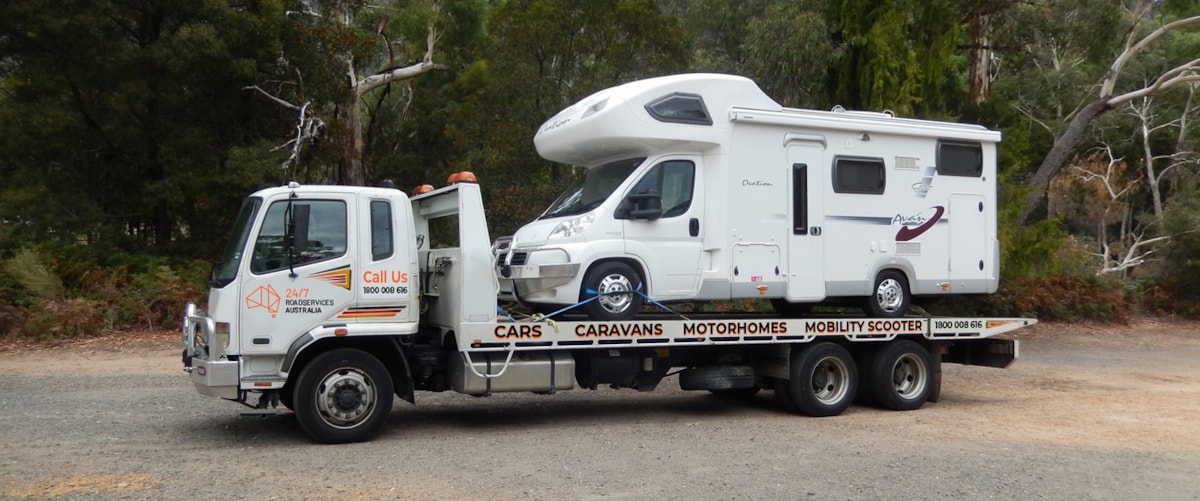
If towing is required, preparing the vehicle by checking whether the transmission and the handbrake can be released, removing personal belongings or clearing access to spare tyres can help speed up the process.
Tips to avoid roadside issues
Check tyres regularly and replace based on age
Tyres should be checked before every travel day, including pressure, visible wear and sidewall condition. Many motorhome tyres fail due to age rather than tread wear, so travellers should check the manufacture date and replace tyres that are nearing the end of their recommended lifespan. Correct tyre pressure for the vehicle’s load is critical, as under-inflated tyres generate excessive heat and are far more likely to fail.
Avoid overloading the RV
Overloading places extra strain on tyres, brakes, suspension and cooling systems. To reduce weight, travellers should regularly review what they’re carrying and remove items that aren’t essential. Travelling with empty water tanks where possible, limiting duplicate kitchen gear, and being mindful of heavy add-ons like generators or storage boxes can make a significant difference. Checking the vehicle’s gross vehicle mass (GVM) and weighing the motorhome at a public weighbridge helps ensure it’s operating within safe limits.
Test and maintain batteries
Batteries should be tested regularly, especially before long trips or off-grid travel. Travellers can check battery health by monitoring voltage levels, ensuring terminals are clean and secure, and having batteries load-tested during routine servicing. Being mindful of overnight power usage and understanding which systems draw from which batteries can help prevent unexpected failures.
Service RVs more frequently than standard vehicles
Motorhomes experience higher loads and longer driving periods than most passenger vehicles, so more frequent servicing is recommended. Before long trips, belts, hoses, coolant levels and fans should be inspected, and any signs of wear addressed early. Preventive maintenance is one of the most effective ways to avoid roadside breakdowns.
Plan fuel stops in advance
Fuel planning is essential when travelling in regional or remote areas. Travellers should research fuel availability ahead of time, allow for higher fuel consumption, and avoid running tanks too low. Carrying extra fuel where permitted and safe can provide added peace of mind on longer stretches.