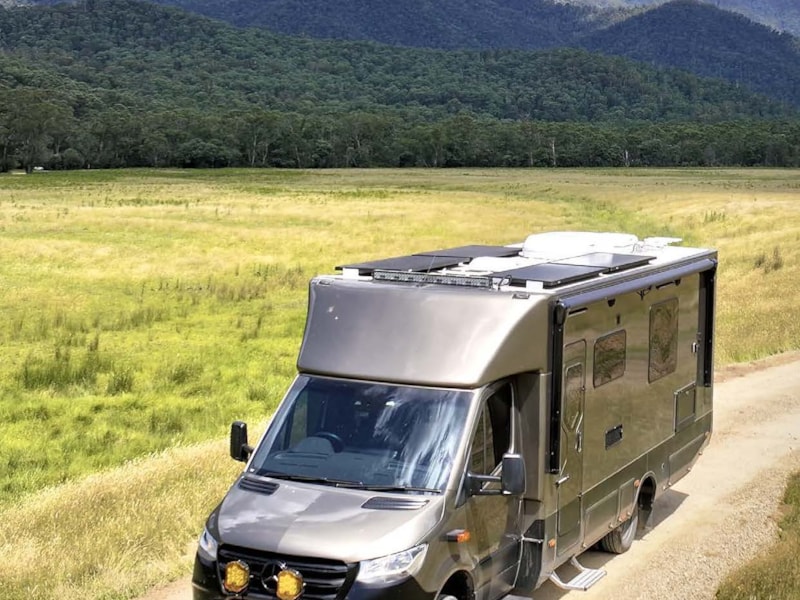
I suspect that many readers of this fine column can remember a time when their toolbox contained, among other things, a full set of spanners and sockets, a spark plug socket, a set of feeler gauges and, for the more sophisticated, a dwell meter and timing light. Some of those items are still in my toolbox but don’t get much use these days, particularly as some of them are for petrol engines while many of us have turbo diesel engines in either our motorhomes or tow vehicles.
Because of the increasing sophistication of turbo diesel technology and related items, the work that can be done by an average handyperson on engines has become much more limited. I also have a feeling that age and mobility might be a factor here too — I have noticed that scrabbling under dashboards or crawling under vehicles has become less attractive as the years go by.
Motorhomes in particular have much more that the engine and associated mechanicals of course, and that’s similar to caravans in many ways; there are still quite a number of items that can be, and in some cases, should be, maintained and/or fixed, particularly in older models.
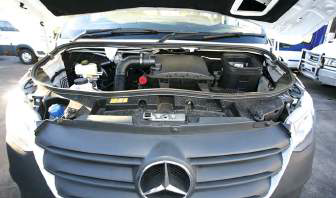
Under the hood of a Mercedes Sprinter
ENGINE AND OTHER MECHANICALS
On many modern turbo diesel engines, unless a skilled mechanic regularly checks on fluid levels — engine oil, transmission fluid, coolant, and windscreen — the latter are about the only maintenance items that can be done at home, apart from items like oil, coolant, and filter changes. Tyres are in a slightly different category and regular (daily, in some cases of constant travel) checks on air pressure are pretty much a mandatory safety item. The occasional look at tread depth and general tyre wall condition isn’t a bad idea either.
MAINTAINING THE HOUSE
Basic maintenance on any motorhome or caravan can be as simple as a general clean inside and out. That should include the rooftop items like roof hatches and solar panels, along with the awning. Anything flapping loose or not closing properly should certainly receive attendance.
Apart from the awnings, doors, windows, and drawers, there are not a huge number of moving parts in a caravan or motorhome — but anyone with a slide-out should certainly pay attention to keeping any tracks and rollers free of dirt and dust. Any seals should be lubricated as required, and it’s always best to check your maintenance manual.
Another item with seals is the toilet cassette. A little lubricant is good but it should not be petroleum-based — olive oil is often fine. Water heaters don’t require much attention, but the sacrificial anode that does corrode should be replaced from time to time.
Not everyone has one, but portable generators do require occasional maintenance. For those that are used infrequently, it might be nothing more than running them occasionally just to lubricate everything. It’s a similar case for air conditioners.
Batteries, once a necessary maintenance item, being mostly fully sealed these days, require little attention. However, with fairly sophisticated battery/solar panel/battery management systems, it’s a good idea to learn the basics of the control panel readouts and be warned if there’s a problem lurking. Tech heads will undoubtedly have something very interesting to play with.
Likewise, 12V systems don’t require much maintenance, but it’s a good idea to regularly check that all running lights, brake lights, and reversing lights are functioning properly. On caravans, one item that deserves a little attention is the plug that connects to the tow vehicle. Keeping it clean is good practice and that involves nothing more than simply keeping it off the ground.
Also on a caravan, items like brake and bearing maintenance can be handled by a very competent handyperson but many have that done by a caravan service centre.
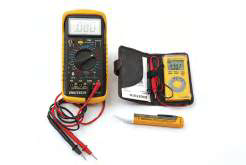
A multimetre is always handy
TWO DON’TS
There are two items that should not be handled by unlicensed persons — one is the gas system, apart from undertaking things like checking for leaks by using soapy water, and the other is the 240V electrics, which should be left to experts. An example of this is the person who buys a cheap 240V power point from a well-known hardware chain but fails to understand that all sockets in any recreational vehicle needs to be a double pole device, i.e. both active and neutral are switched. One item that can be undertaken by a handyperson is the regular inspection of any electrical cords, particularly the one used between caravan park power outlets and RVs. That involves nothing more than looking for any insulation damage or any burn marks (which indicate a bad connection) on the plug or socket. It’s also a good practice to get the electrical cords tagged and tested on a regular basis.
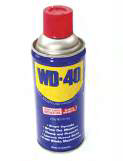
WD-40 is a great lubricant and protector
CARRY A FEW TOOLS
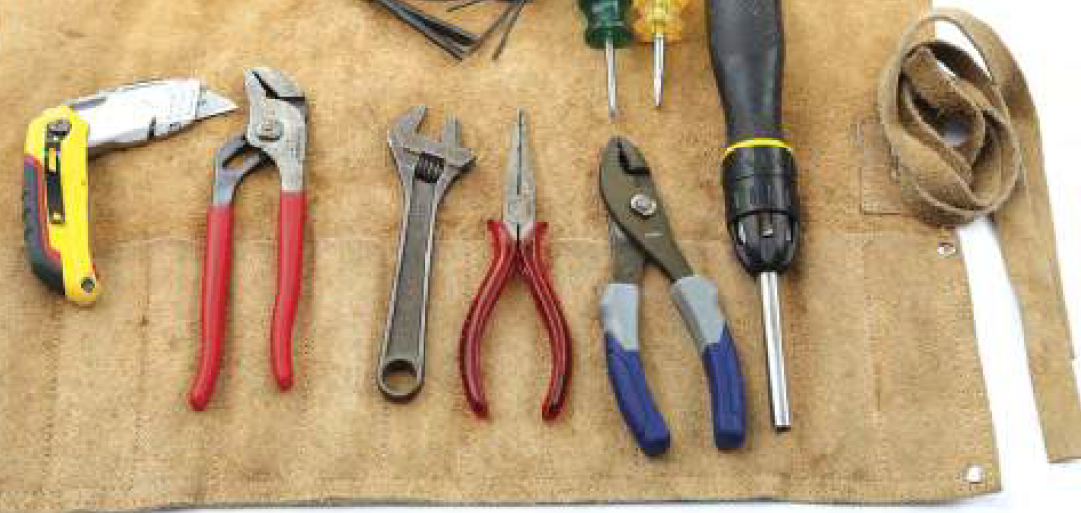
Every motorhome or caravan should have some sort of toolbox, even a simple one for those not particularly handy. The reason being that even if you are not very handy, you’ll still have the necessaries, along with anything that’s a bit unique to your caravan or motorhome. Multi-tools are very much in vogue these days, so a screwdriver with multiple tips, pliers, and a couple of shifting spanners is a good start. A set of Allen keys is always a handy item, as are slip joint pliers or multi-grips and a Stanley knife.
Given the number of devices these days that have very small screws (including eye glasses), a set of jewellers screwdrivers never goes astray, nor do small long nose pliers. After that, it’s very much up to you what you carry. Personally, I find something like a Leatherman multi tool a handy item just to keep stashed in the glovebox. Not really in the tool category but both duct tape and plastic zip ties are often useful in emergencies, as is something like the ubiquitous WD-40!
For those who are technically minded, a small digital multimetre is almost a must-have item. Not only does it allow for batteries of all sizes to be tested, but it can also be a good device for basic electrical fault finding when used in the right way. Another little device in my arsenal is a non-contact voltage detector. It’s handy for detecting when something is electrically ‘live’ when it shouldn’t be. I have used it most when connecting up to less than well maintained caravan park electrical outlets.
In contemporary motorhomes and caravans, there isn’t a great deal of ongoing maintenance required, but with a few simple tools and a bit of attention, your pride and joy can be kept in tip-top and road-ready condition!