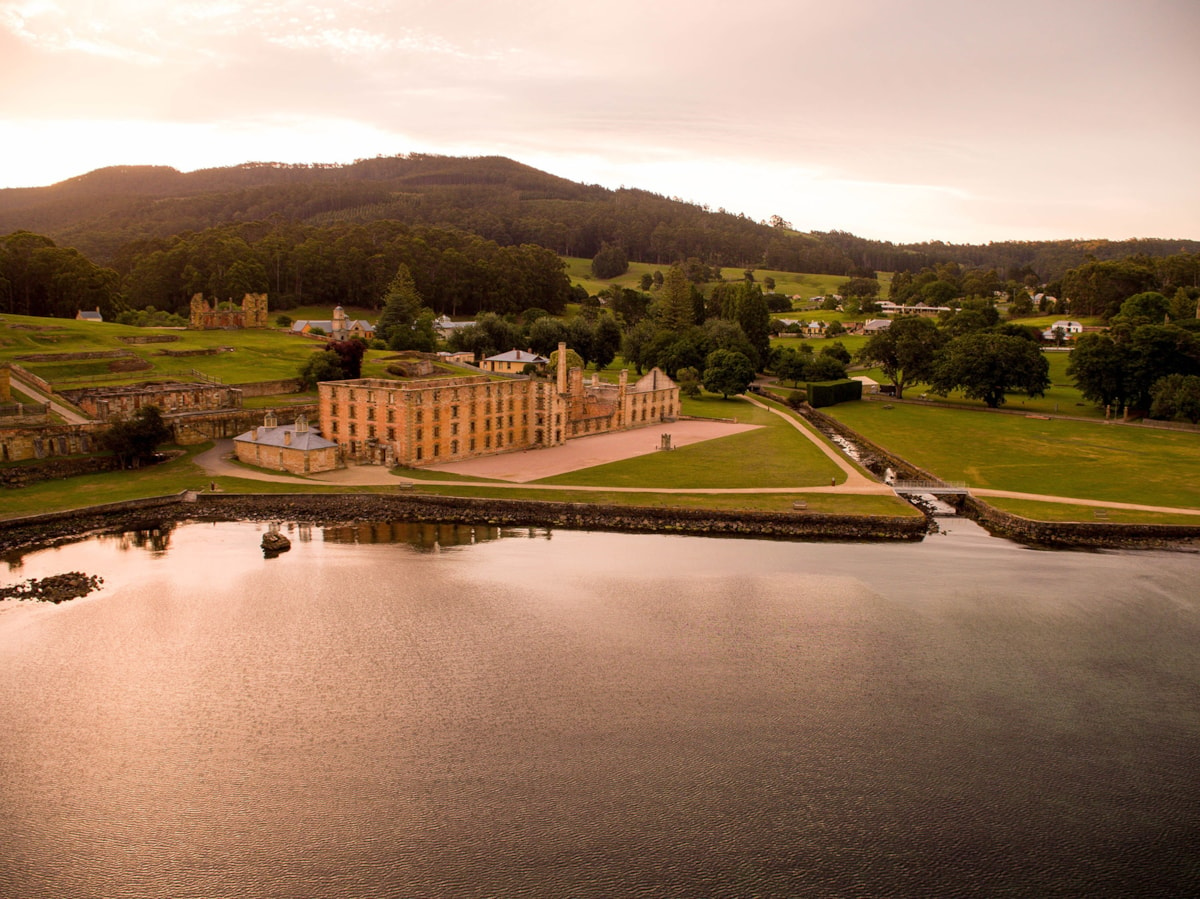
Tasmania’s convict past comes to life on a journey through the historic towns of Port Arthur and Richmond.
We walk through the Separate Prison at the Port Arthur Historic Site, where convicts endured lonely, psychological torture. They were kept in isolation for 23 hours a day. No talking was allowed. Known only by a number, convicts were hooded and masked when moved.
It’s a confronting scene at the beginning of our motorhome journey around Tasmania/lutruwita. We’ve opted to spend a few days close to Hobart, starting our explorations at the Coal Mines Historic Site. Thirty kilometres north-west of Port Arthur, the site was one of 11 Australian convict sites jointly inscribed on the UNESCO World Heritage List in 2010.
Coal was discovered here in 1833, and the mines soon began using convict labour. In the 1840s, more than 600 convicts were stationed here, along with dozens of military personnel and civilians, plus their wives and children. We read the sobering information boards as rain sprinkles down. There are remains of buildings including 10 original underground jail cells.
We wander through the cells shivering (literally), despite it being a summer day. Out loud, we wonder how cold it must have been during winter.
We drive to our pre-booked site at NRMA Port Arthur Holiday Park, set on 16 hectares of bushland. We buy some animal food from the office for $2 and are instantly very popular with the pademelons (small wallaby-like marsupials) and the green rosellas.
The grounds once provided the main source of food for the Port Arthur settlement. Shackled convicts would arrive each day to plant, cultivate and harvest vegetables. When the steady rain stops, we explore the park and admire the water-view cabins. We walk the trail down to Stewarts Bay, but the rain returns and we don’t linger. A cosy pasta dinner inside our RV beckons.

BEAUTY WITH A DARK PAST
The next day, we have a private walking tour at Port Arthur. Claire is our Guide. Despite it being mid-February, it’s a cold, windswept day of just 13°C, with on-and-off-again rain squalls. Claire reminds us that south of here lies nothing but the Southern Ocean and Antarctica. In between the rain, there are bursts of sunshine which spotlight the beauty of the natural landscape and the architecture.
Operating from 1830, Port Arthur is another World Heritage convict site. During 47 years as a penal settlement, more than 12,500 convicts served their sentences here. A general admission ticket entitles you to entry over two consecutive days and includes a 20-minute cruise. Claire tells us that visitors are important to the site’s preservation, as 84 per cent of funding for Port Arthur comes ticket sales.
We learn about the Port Puer boys’ reformatory (puer meaning ‘youth’ or ‘boy’ in Latin). Built in 1834, this was the first purpose-built boys’ prison in the British Empire. Indeed, it was also the first compulsory schooling in the British Empire. Over 15 years, more than 2,000 boys lived, worked and studied here.
In the 1830s, prisoners as young as nine were transported to Australia (the age of responsibility at the time was a mere seven). Jails were overcrowded ‘universities of crime’, with men, women and children all imprisoned together. The aim at Port Puer was to keep boys away from adult prisoners. They were taught trades like shoemaking and stonecutting. They also received compulsory religious education or ‘moral reformation’.
After lunch at Port Arthur Cafe, we board the cruise around the sheltered harbour. Prisoners were brought to Port Arthur, on the Tasman Peninsula, by sea from Hobart. Once they arrived, escape was difficult as the overland route required crossing the narrow, natural isthmus onto the Forestier Peninsula, and on to the main landmass of Tasmania. The isthmus, called Eaglehawk Neck, was guarded by a ‘Dog Line’ – a chain of fierce dogs stretched across the Neck, with more stationed on platforms in the water.
We cruise past the Isle of the Dead where there are two distinct cemeteries. The higher burial ground was for the military and civilians, where the graves are formally marked with headstones. The lower ground was for the convicts, and the graves are largely unmarked.

SWEET AND SOUR
We travel on to Hobart and base ourselves at the BIG4 Hobart Airport Tourist Park. One morning, we drive 25 kilometres north to picture-postcard Richmond to explore more convict heritage and appreciate the beautiful Georgian architecture. Richmond is small so we park our RV and explore on foot.
Starting with breakfast at Czegs’ Cafe, housed in a cottage dating from 1831, we sit on the front verandah and sip cappuccinos. After breakfast, we walk to Richmond Bridge – the oldest surviving bridge in Australia. Started in 1823, the convict-built bridge used local stone and cost an estimated £2,000 – staggering at the time given tradesmen only earned about £40 a year.
Our next stop is another ‘oldest’ site, this time the oldest existing Catholic Church in Australia – St John the Evangelist Church, circa 1836. Next, we spend some time at Richmond Gaol – another oldest landmark. Built between 1825 and 1840 by convicts who quarried the stone and cut the timber, the gaol is Australia’s oldest intact colonial prison.
The information boards are fascinating. We learn that women in Australia were not flogged. And the men who were flogged were, unsurprisingly, badly scarred. Some wore their scars as a badge of honour, others hid their scars to conceal their convict past. We are solemn as we stand in the flogging yard with its ‘cat o’ nine tails’ whip on display.
After learning about the gaol’s gruesome past, we wander the very pretty main street, aptly named Bridge Street. It’s lined with heritage buildings, cafes, shops and accommodation, and we pay a mandatory visit to Sweets & Treats The Richmond Lolly Shop. Presents for home (and some cheeky late-night munchies) must be bought! They will also fuel the rest of our Tasmanian adventures.
JOURNEY PLANNER
Port Arthur is about 100 kilometres south-east of Hobart, while Richmond is just 25 kilometres north of the city. It’s all highway driving but, as we discover across Tasmania, mostly single carriageway.
If you are spending a full day or two in and around Port Arthur, it’s best to stay at Port Arthur rather than Hobart to minimise driving. Be vigilant driving at night, dawn and dusk as many Tasmanian animals are nocturnal.
STAY
The NRMA Port Arthur Holiday Park has a range of accommodation options from camping sites to cabins. Our TV did not work here but the Wi-Fi did! Pets are not permitted.
The BIG4 Hobart Airport Tourist Park is pet friendly. The Park features cabins as well as powered and ensuite sites. It is only a 15-minute drive from Hobart. Be sure to pre-book sites in summer to avoid missing out.
DO
The Coal Mines Historic Site is free. Port Arthur and Richmond Gaol have admission charges.
EAT AND DRINK
The writer travelled at her own expense with assistance from Tourism Tasmania and Port Arthur Historic Site.
 Richmond Bridge