

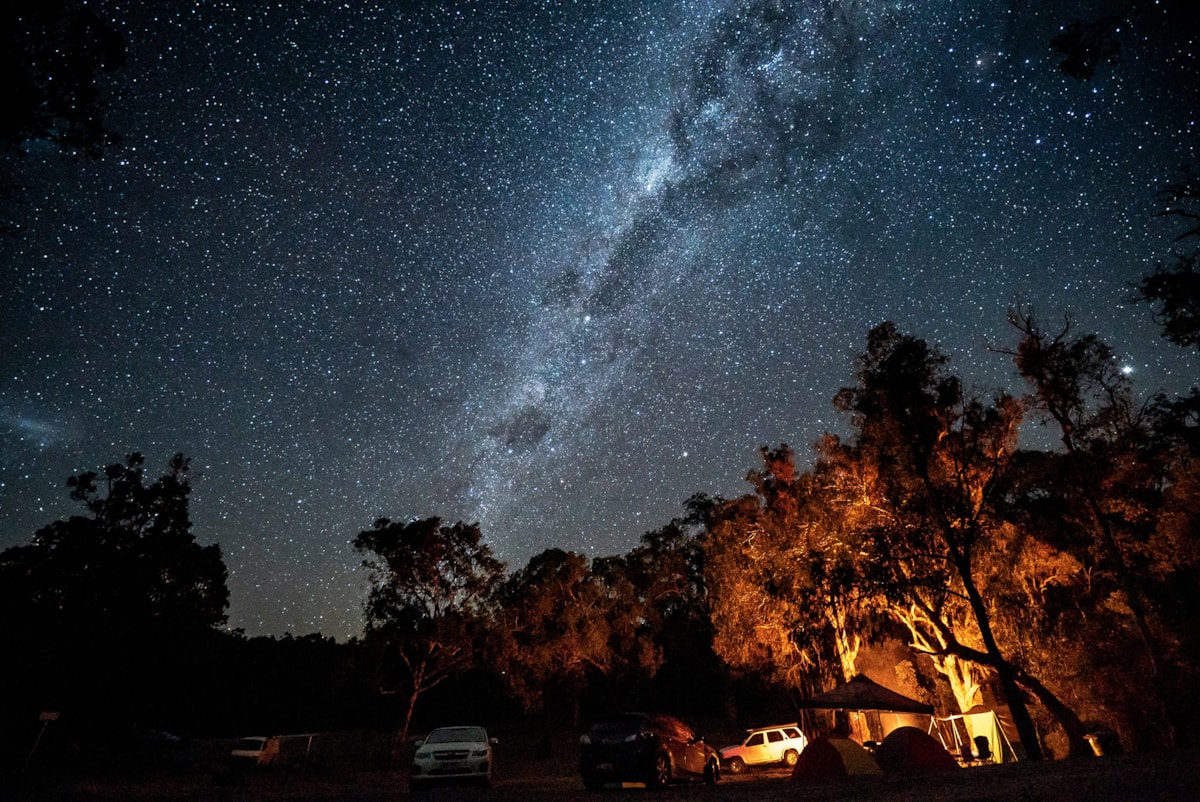
Discover Australia's best dark sky destinations for unforgettable winter nights under the stars.
Winter isn’t just good for stargazing – it’s the best time. The air is drier, the nights are longer and the skies are often clearer than in summer.
Add in Australia’s unique Dark Sky designated areas and you’ve got some of the best stargazing conditions in the world right here at home.
So, rug up, head out and look up. The universe is putting on a show – you must be there to see it.
Warrumbungle National Park, New South Wales
Warrumbungle National Park is basically the benchmark for stargazing in Australia. It’s an officially certified Dark Sky Park and once you’re there, it’s pretty obvious why – there’s just nothing competing with the night sky.
Set in the Orana region of New South Wales, it’s a massive, remote landscape where the Milky Way doesn’t just appear, it dominates. On a clear night, it stretches across the horizon like a glowing river you can actually trace with your eyes.
Right on the edge of the park sits Siding Spring Observatory, home to Australia’s largest optical telescope. It was even relocated here decades ago to escape light pollution from Canberra, which tells you everything about how good the skies are.
Even without telescopes or tours, though, the experience is the same: complete darkness, unreal clarity, and stars on full display. It’s not just a nice stargazing spot; it’s one of the best in the country, full stop.
River Murray Dark Sky Reserve, South Australia
Just a couple of hours from Adelaide, the River Murray Dark Sky Reserve is one of the easiest ways to get properly dark skies without heading deep into the outback. It’s close enough for a weekend trip, but once you’re there, it feels a world away.
Spanning over 3,200 square kilometres, the reserve is tightly protected with almost no development allowed inside its core. At the centre is Swan Reach Conservation Park, a completely untouched pocket of land where the darkness is the main attraction.
Down along the Murray River, it gets even better. The still water reflects the stars so clearly it feels like the sky has doubled, and the whole place slows right down at night. Think campfires, crisp winter air, and long stretches of silence where the stars do all the talking.
It’s the kind of spot where you don’t need a plan – just a blanket, a bit of patience and a sky that keeps getting better the longer you stay out.
Arkaroola Wilderness Sanctuary, South Australia
The night sky out at the Arkaroola Wilderness Sanctuary in the Flinders Ranges is as sharp as it gets. It’s a serious stargazing hub, with multiple observatories, guided astronomy experiences and even the chance to sleep out under a sky full of stars on the Ridgetop Sleepout. Whether you’re using high-tech gear or just lying back in a chair, it all hits differently out here.
But it’s not just about the stars. Arkaroola is rich in geology, wildlife and deep cultural significance to the Adnyamathanha people, making it a place where the landscape itself tells a story.
Go between March and October for the clearest skies and you’ll understand why people travel from all over the world just to look up here.

Outback Queensland
If you’re in Queensland, you don’t need to go far to get proper dark skies, just head inland and the stars switch on in a way you don’t really see on the coast.
Winton is leading the way as Queensland’s first International Dark Sky Community, with skies so clear it’s basically a front-row seat to the universe. It also sits near the Jump-Up Dark Sky Sanctuary, so the stargazing here is seriously next level.
In Charleville, it’s less about just looking up and more about what you’re learning while you do it. At the Cosmos Centre’s Universal Dreaming tour, the night sky comes with Aboriginal star stories, a campfire and marshmallows. It’s stargazing, but with a lot more personality.

Carrickalinga, South Australia
Carrickalinga is a small coastal town on the Fleurieu Peninsula that’s made a big name for itself as an International Dark Sky Community. Just far enough from Adelaide’s glow, and tucked behind low hills, the night sky here stays properly dark and properly impressive.
It’s a place where the beach meets the stars. By day you’ve got white sand, rocky headlands and crystal-clear water. By night, the streetlights fade out and the sky takes over, with minimal light pollution letting the constellations do their thing.
What makes Carrickalinga even more special is the community behind it. Locals have actively worked to protect the dark sky through better lighting, education and conservation efforts, turning it into a real model for astro-tourism in Australia.
It’s also a place with deep cultural roots, with First Nations connections to land and sky that stretch back thousands of years. Today, that history sits alongside a growing focus on protecting the night environment for wildlife, people and future generations.
Tips for Winter Stargazing
-
Layer up: Winter nights get cold, especially inland -
Check the moon phase: A new moon means darker skies -
Get away from lights: Even small towns can affect visibility -
Be patient: Your eyes take time to adjust, but it’s worth it
-
Download a star app: It helps you make sense of what you’re seeing


