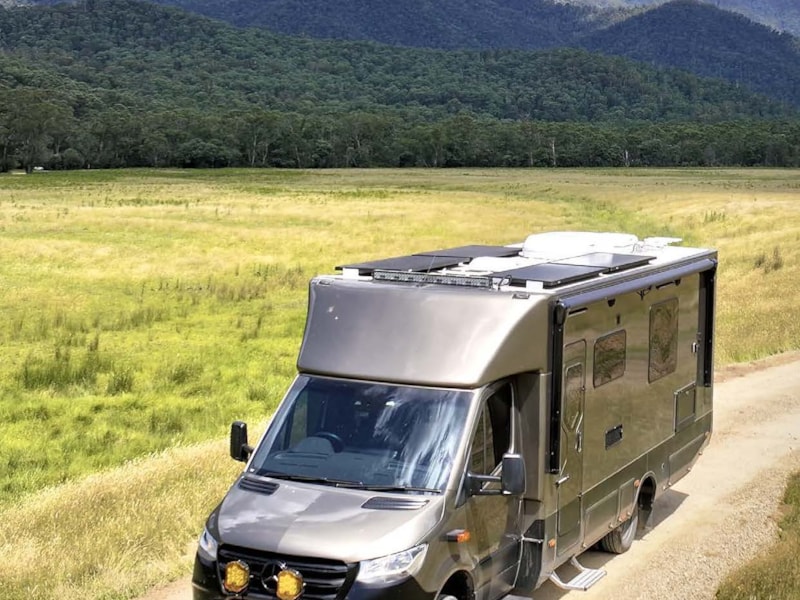
Of all the vehicles that travel on our roads, motorhomes are unique in a number of ways. One of these idiosyncratic features is that of maintenance because there are two different categories, for want of a better word. One is for the base vehicle itself, i.e. mechanical maintenance on the “motor”, and the other is on the “home” part. This month I’ll look at the motor part.
More than 30 years ago, I suspect, many readers of this fine column would have had car ramps in the garage and could lift the bonnet of a car to do an oil change, renew or reset the spark plugs, adjust the points gap, know what a timing light was for, change the brake pads and, for the clever ones, set the mixture and idle on the carburettor.
I must admit that the last one defeated me on my first car. It was a Volkswagen half back and had dual carburettors. Getting those even slightly wrong meant a rapid increase in fuel consumption.
Time, tide, fuel injection, emission requirements, technology, diesel engines and, likely, age has ended the mechanical maintenance routine for many but there are a few simple checks and general maintenance that can be done.
To get a few clues on this I had a chat to the team at Wallaby Motorhomes in Sydney. Wallaby sell a range of used ex rental motorhomes, mostly with Mercedes Benz, Volkswagen or Toyota HiAce base vehicles, but there are some Fiat Ducatos as well.
All the motorhomes will have had various levels of usage. Consequently Wallaby has plenty of experience in motorhome mechanical maintenance.
THE BASICS
First up, the basic checks. Consult your vehicle service book/manual for the necessary items but vehicle manufacturers these days often have bright yellow markings to make it easy. Engine oil and coolant are the most important to check regularly but brake fluid and transmission fluid are also on the list, as are things like air filters and pollen filters (if your vehicle has one), which are very easy to change.
When it comes to more general maintenance, during a warranty period it’s generally best if regular servicing is done by qualified people but when the warranty expires there are some items that can be done by the owner.
Service intervals are something to be considered. For instance, some newer light commercial vehicles are recommended at 30,000km, something readily achievable by a vehicle in commercial service. However, a motorhome is likely to travel far less than that, so time should be considered instead. Although a motorhome may not do the distance of a commercial vehicle, it may still be loaded close to the Gross Vehicle Mass (GVM) which means it is still going to be working hard. Wallaby reckons basic maintenance like oil and filter changes should be done twice a year at about 10,000km intervals.

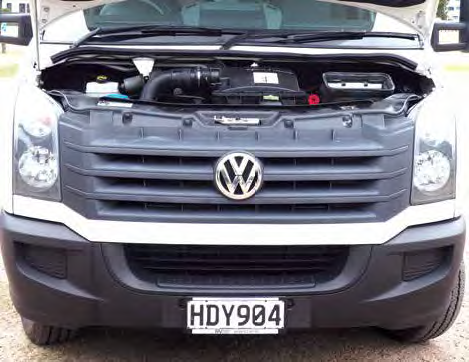
Refer to your manual to make sense of the engine
OIL CHANGE
One of the simplest chores is an oil change, particularly on older vehicles. However, many newer vehicles have hitech oil pumps which can be expensive to replace if the oil change is done incorrectly, so is something best left to a specialist.
ENGINE COOLANT
It does not necessarily need to be changed but, if it needs to be replenished, then the same grade should be used — see the owner’s manual. Coolant is normally colour coded and so it is fairly easy to tell. If coolant needs to be diluted, then distilled water, not tap water, should be used.
BRAKE FLUID, BRAKE PADS AND DISCS
Generally speaking, minor top-ups of brake fluid are all that is needed but if a brake fluid change is necessary, it is best left to those who have the vital air powered bleeding kits.
Brake pads and discs can be changed but how easily this is done does depend on the make of vehicle. In addition to that, appropriately rated jacks and stands must certainly be used — motorhomes are much heavier than standard cars.
ADBLUE
Newer model diesels may have a cap by the fuel filler or in the engine bay for Adblue. It is used in the catalytic converter fitted to the exhaust system and works by being injected into the exhaust gases and burnt at very high temperatures to break down harmful nitrous oxides. Please note it has nothing to do with the diesel fuel and will damage the engine if mixed with the diesel. An engine can run without Adblue but given it is for emission requirements, the engine may be programmed to stop running if the Adblue runs out. Consumption of Adblue varies depending on how the vehicle is driven and could vary anywhere between 600km and 1000km for one litre. Consult your vehicle’s user manual for more details. Adblue can be topped up quite easily (the cap is blue) but be aware that it is corrosive. Wash away any spillage on either vehicle or hands and don’t get it anywhere near the fuel tank!

Older engines can be easier to work with
DIESEL FILTERS
A problem with diesel is that it can hold water in suspension which isn’t good for diesel engines at any time. A fuel filter is fitted to the fuel line and mounted upright so the water drains to the bottom. Fuel filters are often fitted with a tap at the base to drain the water off but most late-model common rail diesels do not have drain plugs in the system because they run at pressures up to 25,000psi (170,000kpa) and caution is a must. Like oil filters, the Wallaby team recommends that filters should be changed every 10,000km due to the poor quality of diesel found in many places in Australia.
AIR FILTERS
Quite easily found, air filters are usually in a round or square-shaped box near the top of the engine. Spring clips hold the box in place and once removed the air filter can be attended to. There are mainly two types, both made with paper elements but are either cleanable or disposable. To some degree here, the time frame depends on how often dusty roads are travelled.
POLLEN FILTERS
Some light commercial vehicles have pollen filters. In Fiat’s Ducato, for instance, they can be found at the base of the windscreen or behind the dashboard centre console. Anyone with hay fever problems might like to pay special attention to replacement intervals.
TYRES
Like oil and filters, tyres for motorhomes don’t quite get the wear and tear that happens in normal commercial usage. Tyre wear is therefore likely to be lighter than normal, but tyres should still be rotated every 20,000km.
There’s a perception that the tyres are directional but that is not correct and, according to the Wallaby team, to get the best wear, rotation is recommended. Another factor to be considered is ageing, whether a vehicle is used or not. According to tyre manufacturers, any tyre over five years old should be inspected for general condition. An ageing clue is cracks in the rubber. Anything over 10 years old should be replaced, whatever the tread condition.
ROAD LIGHTS
Changing light globes is one of the simpler tasks and needs to be done any time a light globe fails. The headlight globes are usually changed in situ with access via the engine bay. However, taillight housings and surface-mounted lamps usually require the light housing/cluster to be unscrewed from the vehicle body. On older motorhomes, if an incandescent/halogen light globe is being replaced, it might be a good time to investigate energy-efficient LED fittings which also give more reliable service.