On a weekend getaway in Hepburn Springs, Catherine Best discovers there’s more to Australia’s oldest spa town than just its therapeutic waters.
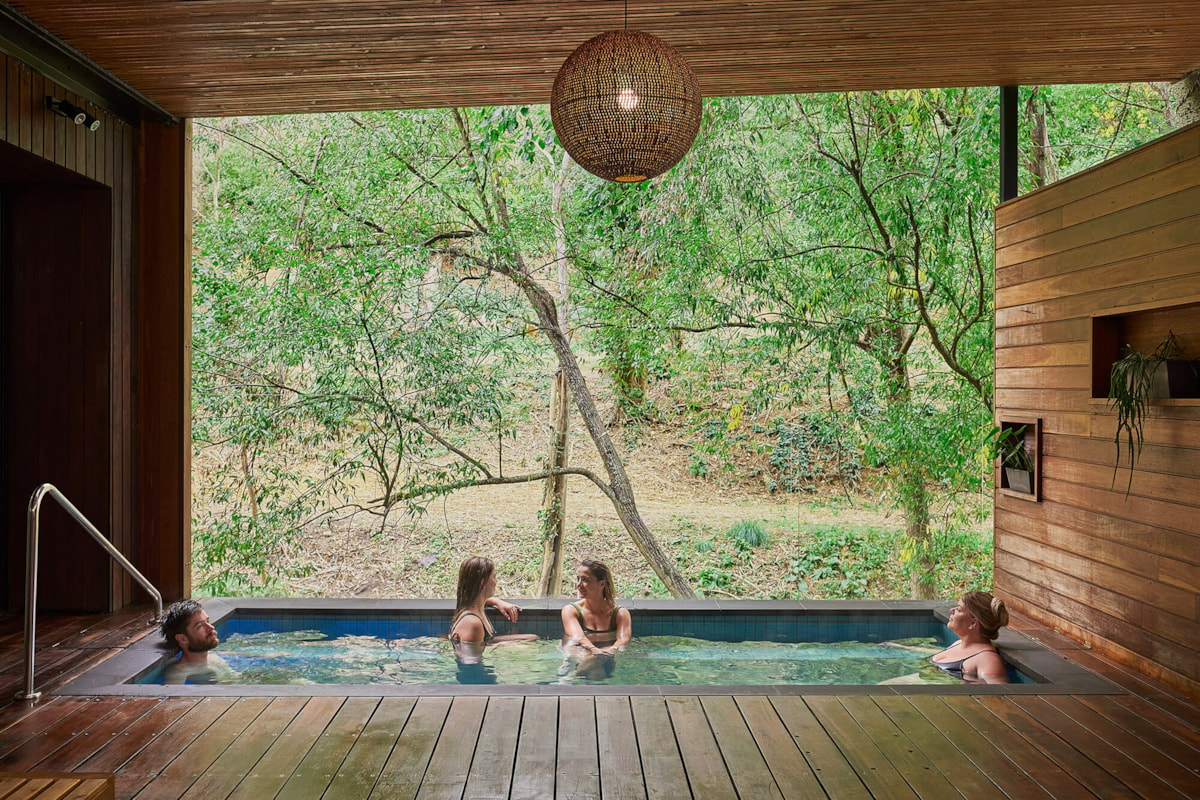
It’s grey and drizzly and the mercury is barely conceding double figures when we shed our winter layers to pull on bathers. Stepping into a public pool in the middle of a Victorian winter is not how I’d ordinarily plan a weekend getaway. But this is no ordinary pool. We’re at Hepburn Springs Bathhouse & Spa in Australia’s oldest spa town and getting wet is not a question of if but how. There are three bathing experiences to choose from – the family-friendly public Bathhouse, kid-free Sanctuary (16-plus), and Private Mineral Bathing. With three kids in tow, we opt for the Bathhouse. Soaring glass windows enclose two inviting pools lined with day beds. The largest is heated to about 36°C and peers out onto the banks of Spring Creek. The smaller spa pool is warmer with vigorous jets that pummel grumbling lower-back muscles into submission.
Behind a wristband-entry door next to the spa is the Sanctuary. Here, the mineral bathing is taken up a notch, with a 39°C creek-side pool, spa couches, salt pool, aromatherapy steam room, sauna and salt-scrub hammam. There’s also a cold-plunge pool and tipping bucket for bathers who enjoy hot-cold torture – I mean therapy. My husband and I tag-team supervising the kids to snatch a few quiet moments to ourselves in the Sanctuary, but I actually enjoy the spaciousness of the Bathhouse.
Bathing in the mineral waters at Hepburn Springs is as de rigueur as climbing the Eiffel Tower in Paris. It simply must be done. The experience is less about hedonism and more about enjoying a cultural tradition that dates back more than 160 years. Even longer when you consider the Dja Dja Wurrung People have long recognised the power of the region’s “special waters” for healing and rest. Early Swiss-Italian settlers were also quick to identify the therapeutic benefits of the springs and, in 1865, succeeded in advocating for the establishment of the Hepburn Mineral Springs Reserve. Introduced at the height of the gold rush, the designation sought to preserve the springs from “the ravages of mining, and for public recreation and amusement”. Three decades later in 1895, after the railways brought an influx of spa tourism to the region, Australia’s first bathhouse opened. It still exists today, despite several redevelopments and extensions over the years. The original bathhouse building is now home to the Hepburn Pavilion Cafe – where you can enjoy Devonshire tea by a roaring fire – and remains Australia’s only surviving heritage-listed 19th century bathhouse. Water – the lifeblood of the spa country – runs through the surrounding grounds. On a walk along the creek systems, water from recent heavy rain gushes beneath arched stone bridges. The reserve is dotted with natural springs where water rich in minerals, including calcium, silica and magnesium, can be hand pumped from the earth. For our kids – expecting a Schweppes-in-a-bottle experience – the taste is a little sharp. The original bathhouse building is now home to the Hepburn Pavilion Cafe – where you can enjoy Devonshire tea by a roaring fire – and remains Australia’s only surviving heritagelisted 19th century bathhouse. Water – the lifeblood of the spa country – runs through the surrounding grounds. On a walk along the creek systems, water from recent heavy rain gushes beneath arched stone bridges. The reserve is dotted with natural springs where water rich in minerals, including calcium, silica and magnesium, can be hand pumped from the earth. For our kids – expecting a Schweppes-in-a-bottle experience – the taste is a little sharp.